The bandwagon effect in advertising is one of the most powerful psychological triggers in marketing. When consumers see millions of people choosing a product, they stop evaluating and start following.
This is not a new phenomenon.
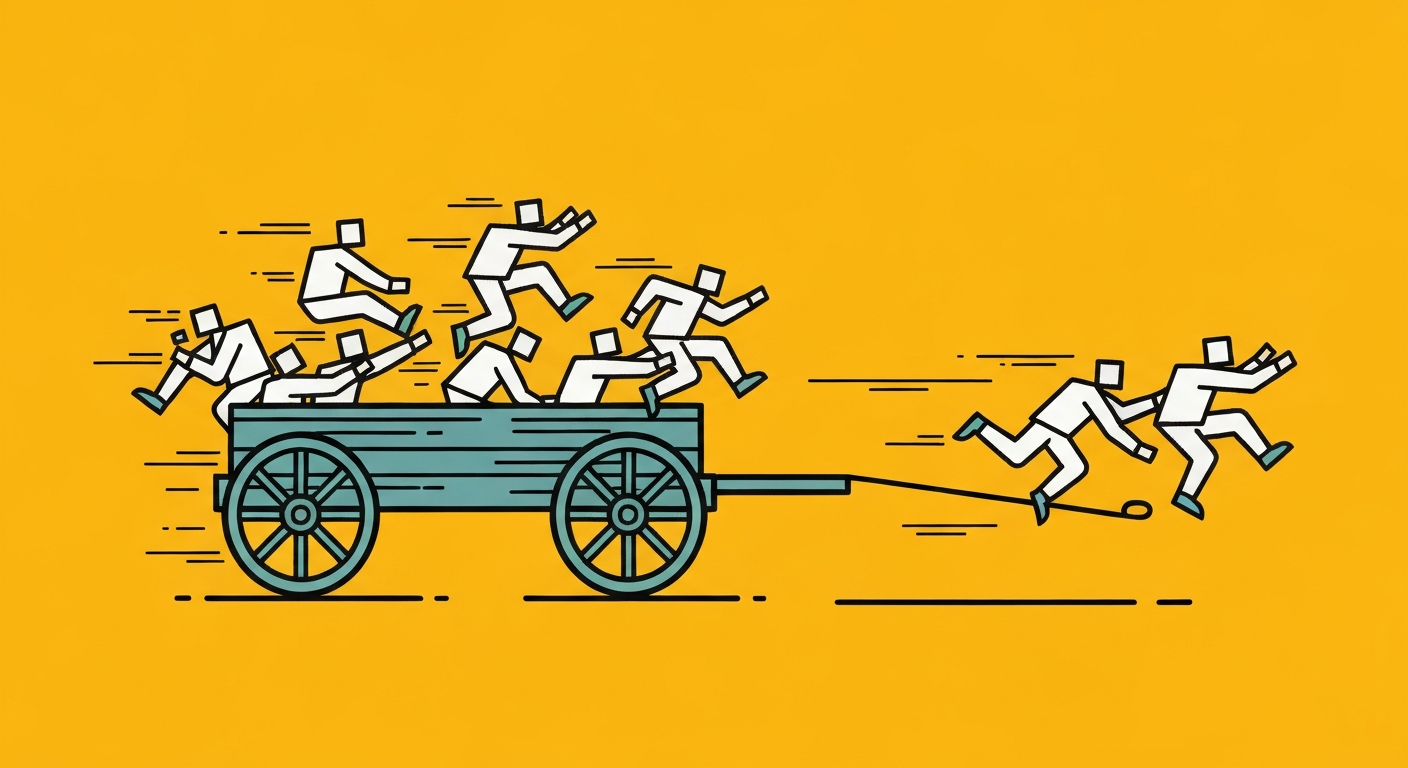
The term traces back to the 1848 U.S. presidential campaign, when circus showman Dan Rice used a literal bandwagon to attract crowds for candidate Zachary Taylor. Politicians noticed that as the wagon drew larger audiences, more people wanted to join the parade. The same principle drives modern advertising, where brands convert social momentum into purchase decisions.
What Is Bandwagon Advertising?
Definition and Origins
Bandwagon advertising is a persuasion technique that encourages consumers to buy a product or adopt a behavior because “everyone else” is doing it. The underlying message is simple: this many people cannot be wrong.
The strategy works across every channel and format. From television commercials citing “America’s #1 brand” to social media posts showing millions of followers, the mechanism stays the same.
At its core, bandwagon advertising replaces individual evaluation with collective validation.
Bandwagon as a Propaganda Technique
The Institute for Propaganda Analysis identified the bandwagon appeal as one of seven key propaganda devices in the 1930s. Their research showed that political campaigns, wartime messaging, and commercial advertising all relied on the same principle: people join movements that appear to already have momentum. This classification matters because it reveals bandwagon advertising’s roots in persuasion science, not just marketing creativity.
Understanding this history helps marketers use the technique with both precision and responsibility. It also explains why regulators scrutinize popularity claims in advertising.
The Psychology Behind the Bandwagon Effect
Social Proof and Conformity
Psychologist Solomon Asch demonstrated the power of conformity in his 1951 line experiments. Participants gave obviously wrong answers just to match the group consensus. In 75% of trials, at least one conforming response occurred, even when the correct answer was visually clear.
Robert Cialdini, behavioral psychologist and author of Influence: The Psychology of Persuasion, later codified social proof as one of six principles of persuasion. His research confirmed what Asch observed: when uncertain, people look to others for guidance on what to do, buy, or believe.
Fear of Missing Out (FOMO)
FOMO is the emotional fuel behind the bandwagon effect.
When Spotify Wrapped goes viral each December, millions of non-users see their friends sharing listening stats across social media. The implicit message is not “Spotify has good music.” The message is “you are missing a shared cultural experience.” Neuroscience research published in PNAS and Psychosomatic Medicine has found that social exclusion activates the same neural regions as physical pain, including the dorsal anterior cingulate cortex, making FOMO a potent driver of consumer behavior.
Herd Behavior and Information Cascades
Economist Sushil Bikhchandani’s work on information cascades explains why bandwagon effects can snowball rapidly. When early adopters choose a product, later consumers interpret those choices as information signals, even when they have no insight into why the early adopters chose it.
| Psychological Driver | How It Works | Advertising Application |
|---|---|---|
| Social Proof | People follow what others do when uncertain | User counts, testimonials, ratings |
| FOMO | Fear of exclusion triggers action | Limited-time offers, viral campaigns |
| Conformity | Desire to align with perceived majority | “Join millions who already…” messaging |
| Information Cascades | Early adopters signal value to latecomers | Launch day buzz, waitlist marketing |
| Herd Behavior | Following the crowd reduces decision effort | “Best-seller” labels, trending tags |
This table is not academic abstraction. Every row maps to a specific advertising tactic you can deploy this quarter.
Bandwagon Advertising Techniques
Popularity Claims
The simplest bandwagon technique is stating how many people have already chosen your product. McDonald’s “Billions Served” is the most recognized example in advertising history. The number itself communicates safety, quality, and social acceptance without any further argument.
SaaS companies replicate this with “trusted by 50,000+ teams” badges on landing pages.
Popularity claims work best when the number is specific and verifiable. “Over 2 million customers” outperforms “lots of happy customers” because specificity signals confidence and transparency.
Celebrity and Influencer Endorsements
When a celebrity uses a product, their audience perceives mass validation through a single figure. Influencer marketing operates on the same logic at a more targeted scale.
Nike’s roster of athlete endorsements does not just sell shoes. It tells consumers that the world’s best performers have already made this choice, so you should too.
User-Generated Content Campaigns
User-generated content turns customers into bandwagon ambassadors.
Coca-Cola’s “Share a Coke” campaign printed 250 of the most popular names on bottles, turning every purchase into a social media moment. The campaign generated over 500,000 photos shared on social media with the #ShareACoke hashtag. Each post served as a public endorsement that pulled more consumers into the movement. The genius was making participation feel personal while the scale felt universal.
Social Media Virality and Hashtag Movements
TikTok has turned bandwagon advertising into a native content format. Brand challenges like Chipotle’s #GuacDance and e.l.f. Cosmetics’ #EyesLipsFace campaign generate millions of user videos that function as free bandwagon advertising.
The platform’s algorithm amplifies content that already has engagement, creating a built-in bandwagon mechanism. Brands that understand this design campaigns for participation, not just consumption.
Limited Availability and Urgency
Scarcity signals demand, and demand signals popularity.
Amazon’s Lightning Deals display a progress bar showing what percentage of the deal has been claimed. When consumers see that 78% of a deal is already gone, they interpret heavy demand as social validation. This is bandwagon psychology packaged as a call to action. The fear of missing what others are grabbing drives faster conversions than any product description could.
Testimonials and Statistics
Review counts function as bandwagon signals in e-commerce. A product with 15,000 reviews communicates mass adoption even before a consumer reads a single review.
Booking.com layers multiple bandwagon cues on every listing: “Booked 12 times in the last 24 hours,” “4 people are looking at this right now,” and star ratings with review counts. Each element reinforces the message that this is where the crowd is going.
8 Bandwagon Advertising Examples That Worked
Apple’s “Get a Mac” Campaign
Apple’s 2006 campaign positioned Mac users as the cool, modern majority while PC users were portrayed as outdated. The bandwagon message was implicit: smart, creative people have already switched.
McDonald’s “Billions Served”
The counter on McDonald’s signs is pure bandwagon psychology. When a brand can claim billions of customers, quality debates become irrelevant. The sheer volume of social proof ends the conversation.
This approach works because humans use popularity as a heuristic for quality when they lack time or expertise to evaluate independently.
Spotify Wrapped
Spotify Wrapped turns data into social currency.
Every December, Spotify users share their personalized listening summaries across Instagram, Twitter, and Facebook. The campaign generated nearly 60 million shares in 2021, creating a tidal wave of organic brand awareness. Non-users see the cultural moment happening without them, and Spotify consistently reports spikes in app downloads during Wrapped season.
Nike “Just Do It”
Nike’s tagline unites a global community of athletes, fitness enthusiasts, and aspirational buyers. The brand’s advertising consistently shows diverse people all choosing Nike, sending the message that this is the default choice for anyone who takes performance seriously.
When combined with earned media from athlete endorsements, Nike’s bandwagon effect compounds across channels.
Amazon Prime Day
Amazon created a shopping holiday out of nothing.
Prime Day works because the event itself generates massive media coverage, social media discussion, and consumer anticipation. In 2023, Prime Day generated $12.7 billion in U.S. online sales alone, according to Adobe Analytics. The bandwagon effect makes non-Prime members feel excluded from a cultural shopping moment, driving Prime subscription sign-ups. Amazon turned artificial urgency into genuine mass participation.
Peloton’s Community Effect
Peloton’s leaderboard feature and community challenges turn individual workouts into shared experiences. The brand grew not because of equipment specifications but because users wanted to join a fitness movement.
This is bandwagon advertising embedded in the product itself.
TikTok Brand Challenges
TikTok’s format makes bandwagon participation effortless. When e.l.f. Cosmetics launched the #EyesLipsFace challenge with an original song, the campaign generated over 7 billion views and became the most viral branded campaign in TikTok U.S. history. Each user video functioned as an individual endorsement that made the next viewer more likely to participate. The campaign cost a fraction of a traditional media buy while generating more conversion rate impact than any television spot could.
Slack’s Growth Messaging
Slack displayed “Millions of people use Slack every day” across its homepage and ads during its growth phase. For IT decision-makers evaluating workplace tools, this popularity claim reduced perceived risk and accelerated adoption in enterprise accounts.
Bandwagon vs Social Proof: What Is the Difference?
Marketers often use these terms interchangeably, but there is a meaningful distinction. Social proof is the broader psychological principle: people look to others’ behavior for guidance. The bandwagon effect is a specific application of social proof that emphasizes mass participation and momentum.
Social proof includes expert endorsements, certifications, and small-group recommendations. The bandwagon effect specifically requires the perception of widespread, growing adoption.
A restaurant with a Michelin star uses social proof through authority. A restaurant with a line out the door uses the bandwagon effect through visible demand.
In practice, the most effective advertising campaigns layer both. Apple uses expert reviews (social proof) alongside global user counts (bandwagon) to build an ecosystem of validation that targets different psychological triggers simultaneously.
The Anti-Bandwagon: When Brands Go Against the Crowd
Apple’s “Think Different” Paradox
Apple’s most iconic campaign told consumers to reject the crowd. Yet “Think Different” created its own bandwagon of nonconformists, a tribe united by the belief that they were independent thinkers.
This paradox reveals something important about human psychology. Even rebellion can be packaged as a movement. The campaign succeeded precisely because it made individuality feel collective.
Liquid Death’s Punk Marketing
Liquid Death sells water in tallboy cans with heavy metal branding.
The brand explicitly rejects mainstream beverage marketing conventions. Yet it achieved a $1.4 billion valuation by 2024, up from $700 million in 2022, by creating a counter-cultural bandwagon that appeals to consumers who identify as anti-mainstream. The lesson for marketers is clear: you do not need to follow the existing crowd. You can create a new one. Anti-bandwagon positioning works when the target audience defines themselves by opposition to the mainstream.
Risks and Ethical Considerations
Bandwagon Fatigue
Consumers are becoming more sophisticated about marketing funnel tactics. When every brand claims to be “#1” or “trusted by millions,” the signal loses its power.
Psychological research on reactance theory suggests that excessive popularity claims can trigger reactance, a psychological response where consumers deliberately choose the opposite of what they are told to do. This is especially true among younger demographics who value authenticity over popularity.
Inauthenticity and Backlash
Fyre Festival is the cautionary tale every marketer should study.
The festival used influencer endorsements and social media hype to create a massive bandwagon. When reality failed to match the manufactured momentum, the backlash was catastrophic. Fabricated bandwagon signals destroy brand trust faster than any competitor attack. The gap between promised popularity and actual experience must be zero, or the entire strategy collapses.
Ethical bandwagon advertising relies on genuine participation data, verified user counts, and authentic testimonials. Inflating numbers or manufacturing fake momentum is not just unethical. It is a business risk that regulators like the FTC actively police.
How to Apply Bandwagon Advertising to Your Campaigns
Start by auditing your existing social proof assets: user counts, reviews, case studies, media mentions, and community size. These are the raw materials for bandwagon messaging.
Then prioritize visibility. The bandwagon effect only works when the crowd is visible. Put your strongest adoption metrics in headlines, not buried in footer text. Display real-time usage data, customer logos, and community activity where prospects encounter them during their customer journey.
Finally, design for participation, not just consumption. The most effective modern bandwagon campaigns, from Spotify Wrapped to TikTok challenges, give consumers a role in spreading the movement.
FAQs
What is the bandwagon effect in advertising?
The bandwagon effect in advertising is a persuasion technique that encourages consumers to purchase a product or service because a large number of other people are already doing so. It leverages herd psychology and social proof to reduce perceived risk and accelerate buying decisions.
How is the bandwagon technique used as propaganda?
The Institute for Propaganda Analysis classified the bandwagon appeal as one of seven propaganda devices in the 1930s. In propaganda, the technique pressures people to join a cause by claiming that “everyone” supports it. In advertising, the same mechanism drives purchase behavior through popularity claims and mass adoption messaging.
What is the difference between bandwagon and social proof?
Social proof is the broad psychological principle where people look to others for behavioral guidance. The bandwagon effect is a specific form of social proof that emphasizes mass participation and growing momentum. Social proof includes expert endorsements and certifications. The bandwagon effect requires the perception of widespread, popular adoption.
Can the bandwagon effect backfire in marketing?
Yes. Bandwagon advertising backfires when popularity claims are fabricated, when consumers experience “bandwagon fatigue” from overexposure to #1 claims, or when the product experience fails to match the manufactured hype. The Fyre Festival disaster is the most cited example of bandwagon marketing that destroyed brand credibility.
What are the best examples of bandwagon advertising?
McDonald’s “Billions Served,” Spotify Wrapped, Apple’s “Get a Mac” campaign, Coca-Cola’s “Share a Coke,” and Amazon Prime Day are among the most effective bandwagon advertising campaigns. Each uses a different mechanism, from raw numbers to social sharing to manufactured urgency, to create the perception of mass participation.
The bandwagon effect remains one of the most reliable tools in a marketer’s arsenal, but only when it is built on genuine momentum. For more on the psychological techniques behind effective advertising, explore our guide to propaganda techniques in advertising and our breakdown of types of advertising that shape consumer behavior.