Best Buy Slogans: How “You, Happier” Beat Amazon
Best Buy survived the retail apocalypse that killed Circuit City and RadioShack by doing something counterintuitive: they stopped competing on price and started competing on happiness.
While Amazon built a convenience empire and Apple perfected premium positioning, Best Buy carved out the middle ground as the technology advisor who wouldn’t pressure you into buying anything.
The company’s slogans tell the story of this transformation. From aggressive price claims in the 1990s to the “You, Happier” positioning that launched during the 2008 financial crisis, each slogan reflects Best Buy’s response to existential threats.
Understanding this evolution reveals how traditional retailers can adapt their brand positioning to survive digital disruption while maintaining relevance with both price-sensitive shoppers and tech enthusiasts.
12 Best Buy Slogans and Taglines Throughout History
| Slogan | Years Active | Campaign Focus | Strategic Purpose |
|---|---|---|---|
| Turn On the Fun | 1983-1989 | Entertainment focus | Early positioning around audio/video entertainment |
| Buyer Be Happy | 1989-1999 | Customer satisfaction | Play on “buyer beware” with satisfaction guarantee |
| The World’s Leading Technology Store | 1999-2003 | Market dominance | Establish category leadership claim |
| Great Prices, No Pressure | 2003-2008 | Price and service | Counter aggressive sales tactics stereotype |
| Reward Zone Members Save More | 2007-2012 | Loyalty program | Drive repeat purchases through membership |
| You, Happier | 2008-2012 | Emotional connection | Shift from price to customer satisfaction |
| Nobody Does Black Friday Like Best Buy | 2010-2018 | Holiday sales events | Own the biggest retail shopping day |
| Making Technology Work for You | 2012-2015 | Service expertise | Position as technology consultant |
| Thousands of Possibilities. Get Yours. | 2015-2017 | Product variety | Highlight selection advantage over specialists |
| Expert Service. Unbeatable Price. | 2017-2019 | Service and value | Defend against Amazon with human expertise |
| Let’s Talk About What’s Possible | 2019-2021 | Consultation approach | Frame shopping as collaborative discovery |
| We’re Here to Help | 2021-Present | Support and service | Pandemic-era emphasis on assistance |
“You, Happier” – The Slogan That Saved Best Buy
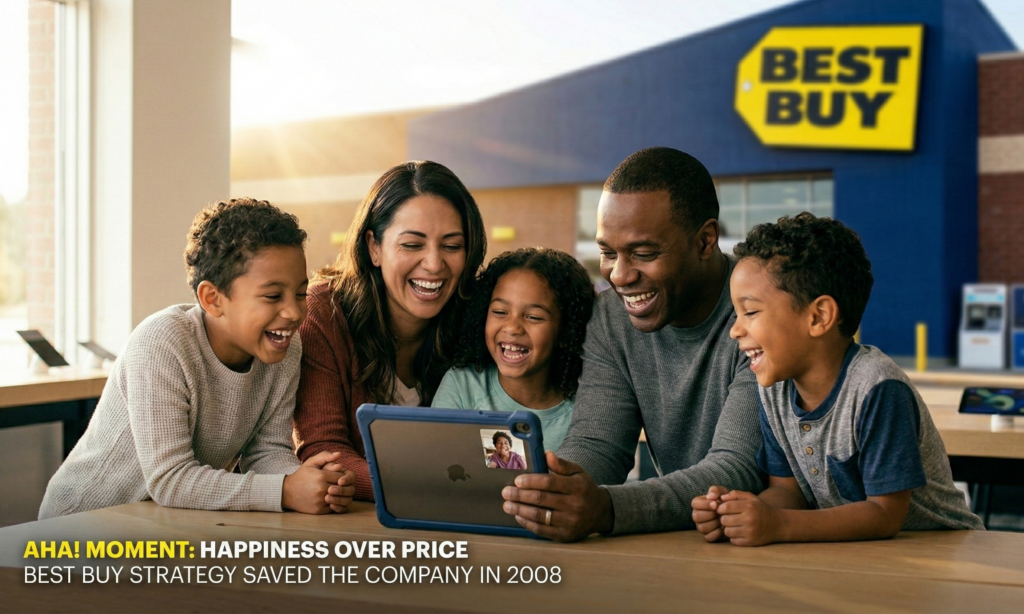
When Best Buy launched “You, Happier” in November 2008, the timing seemed catastrophic. Circuit City had just announced bankruptcy, Borders was struggling, and consumers were cutting discretionary spending as the financial crisis deepened. A slogan about happiness during an economic meltdown? It proved to be exactly what Best Buy needed.
The campaign marked a fundamental shift in how Best Buy talked to customers.

Previous taglines like “Great Prices, No Pressure” focused on transaction mechanics. “You, Happier” flipped the conversation to outcomes. The difference between defensive positioning and aspirational promise.
The Creative Strategy Behind the Campaign
Crispin Porter + Bogusky, the agency behind the campaign, recognized that technology purchases had become anxiety-inducing ordeals. Consumers faced overwhelming choices between similar-looking devices with incomprehensible spec sheets. Best Buy’s Geek Squad had already established the company as the place to go when technology broke, but “You, Happier” positioned them as the place to go before you bought anything.
The campaign’s television spots avoided typical retail approaches of showcasing products and prices. Instead, they showed moments of technology seamlessly solving real problems: a father connecting with his deployed soldier son through video chat, college students collaborating on projects from different dorms.
The tagline appeared after these emotional payoffs, creating a direct connection between Best Buy’s expertise and life satisfaction.
Why It Worked During a Recession
“You, Happier” succeeded because it acknowledged economic reality without dwelling on it. While competitors slashed prices and screamed about deals, Best Buy suggested that smart technology choices could actually improve your financial situation. The campaign featured stories about families reducing cable bills through streaming devices and small businesses becoming more efficient through better equipment.
This positioning proved prescient. As smartphones became essential tools rather than luxury items, and as remote work required home office upgrades, Best Buy’s consultative approach generated higher basket values than pure price competition.
The company’s same-store sales grew 1.8% during the 2009 holiday season while most electronics retailers posted double-digit declines.
The Evolution of Best Buy’s Brand Voice
Best Buy’s messaging evolution reflects three distinct phases of retail strategy, each responding to different competitive threats and consumer behaviors.
The company’s unique selling proposition shifted from price leadership to service differentiation to experience curation, with each transition marked by a corresponding slogan change.
Phase 1: Price Warriors (1983-2008)
Early Best Buy slogans like “Turn On the Fun” and “Buyer Be Happy” established the company as an entertainment destination, but the underlying message remained transactional. The breakthrough came with “Great Prices, No Pressure,” which directly addressed consumer frustrations with high-pressure electronics salespeople.
This positioning helped Best Buy differentiate from Circuit City’s commission-driven sales culture and RadioShack’s aggressive upselling tactics. The “no pressure” promise proved particularly powerful in categories where consumers felt vulnerable to technical manipulation.
Best Buy’s sales associates were trained to educate rather than push, creating a shopping environment that felt more collaborative than predatory.
Phase 2: Service Leaders (2008-2017)
“You, Happier” and “Making Technology Work for You” represented Best Buy’s recognition that price competi tion had become unsustainable. Amazon’s logistics advantages and manufacturer direct-sales programs made it impossible for physical retailers to win on price alone.
Instead, Best Buy doubled down on the human element and the ability to demonstrate products, answer complex questions, and solve integration problems.
This phase coincided with Best Buy’s aggressive expansion of services beyond simple product sales. Geek Squad installations, phone repairs, and technical support became significant revenue streams.
The messaging reflected this broader value proposition, positioning Best Buy as a technology partner rather than just a technology vendor.
Phase 3: Experience Curators (2017-Present)
The current messaging reflects Best Buy’s maturation into an experience-driven ret ailer. “Let’s Talk About What’s Possible” and “We’re Here to Help” acknowledge that technology decisions have become more complex and more personal. Instead of selling individual products, Best Buy now helps customers envision complete technology ecosystems that enhance their lifestyles.
This evolution mirrors broader changes in consumer behavior. As technology literacy increased, customers began approaching purchases with specific scenarios in mind rather than generic needs.
A gaming enthusiast building a streaming setup has different requirements than a remote worker upgrading their home office, even if both need similar components.
Marketing Lessons from Best Buy’s Slogan Strategy
- Timing beats perfection in message pivots: Best Buy’s most successful slogan changes coincided with external pressure points rather than internal strategic reviews
- Service differentiation requires proof points: Service-focused slogans only work when backed by tangible capabilities customers can experience
- Emotional benefits need rational foundations: “You, Happier” connected emotional outcomes to rational purchase decisions, not feelings alone
- Consistent core values enable surface flexibility: Slogans changed while expertise, selection, and service remained constant
Timing Beats Perfection in Message Pivots
Best Buy’s most successful slogan changes coincided with external pressure points rather than internal strategic reviews. “You, Happier” launched during the 2008 financial crisis, “Making Technology Work for You” appeared as tablet adoption complicated device ecosystems, and “We’re Here to Help” emerged during pandemic-driven technology adoption.
This reactive approach worked because Best Buy maintained consistent core values. expertise, selection, and service, while adapting surface messaging to current contexts. The slogans changed, but the underlying brand equity remained stable. Customers knew what to expect from Best Buy regardless of which campaign was running.
Service Differentiation Requires Proof Points
Best Buy’s service-focused slogans succeeded because they were backed by tangible capabilities that customers could experience and verify. Geek Squad installations provided concrete evidence for “Making Technology Work for You.” Price-matching policies supported “Great Prices, No Pressure.”
This connection between slogan and service delivery became crucial as customer expectations shifted. Once Best Buy promised expertise, customers began evaluating store visits based on the quality of advice they received.
The company invested heavily in employee training and product knowledge systems to ensure that the brand promise matched the in-store experience.
How Best Buy Slogans Compare to Retail Competitors
Best Buy’s messaging strategy stands apart from other major electronics retailers through its emphasis on consultation over competition. While Amazon focuses on convenience (“Delivered Tomorrow”) and Walmart emphasizes savings (“Save Money. Live Better”), Best Buy consistently positions itself as the expert guide in technology decisions.
Amazon: Convenience vs. Consultation
Amazon’s retail messaging centers on frictionless transactions: one-click ordering, fast delivery, easy returns. Their approach assumes customers know what they want and simply need the most efficient way to get it. Best Buy’s slogans take the opposite approach, assuming customers need help figuring out what they want in the first place.
This difference reflects distinct customer acquisition strategies. Amazon excels at capturing demand that already exists, while Best Buy specializes in creating demand through education and demonstration.
Walmart and Target: Price vs. Experience
Mass retailers like Walmart and Target position electronics as commodity categories within broader value propositions. Their messaging rarely addresses technology-specific concerns about compatibility, setup, or long-term support. Best Buy’s slogans consistently acknowledge that electronics purchases require different considerations than typical retail transactions.
This positioning allows Best Buy to maintain higher margins in categories where Walmart and Target compete primarily on price.
By framing the conversation around outcomes rather than specifications, Best Buy justifies premium pricing through superior brand awareness in the technology consultation space.
Frequently Asked Questions
What is Best Buy’s current slogan?
Best Buy currently uses “We’re Here to Help” as its primary slogan, launched in 2021 during the pandemic. The company also uses situational taglines like “Nobody Does Black Friday Like Best Buy” for specific campaigns, but “We’re Here to Help” appears most consistently across advertising and store communications.
Why did Best Buy change from “You, Happier” to other slogans?
Best Buy retired “You, Happier” in 2012 as economic recovery reduced the appeal of happiness-focused messaging and increasing competition from online retailers required more specific value propositions.
“Making Technology Work for You” better communicated Best Buy’s technical capabilities and service advantages during the rise of complex device ecosystems.
How does Best Buy choose new slogans?
Best Buy typically develops new slogans in response to major market shifts or competitive threats rather than following predetermined timelines. The company works with advertising agencies to test messaging concepts and measures effectiveness through brand tracking studies, with recent slogans emerging from customer research identifying specific pain points in technology adoption.
Do Best Buy slogans affect sales performance?
Best Buy’s most successful slogan transitions have coincided with improved financial performance, though isolating messaging impact from operational changes proves difficult. “You, Happier” supported same-store sales growth during the 2008-2009 recession, while “Making Technology Work for You” accompanied the company’s successful pivot to services revenue.
How do Best Buy’s slogans compare to other electronics retailers?
Best Buy’s slogans consistently emphasize expertise and consultation, while competitors focus on price, convenience, or selection. Circuit City used “Where Service is State of the Art,” RadioShack promoted “You’ve got questions, we’ve got answers,” and Amazon emphasizes delivery speed. Best Buy’s approach positions the company as a technology advisor rather than just a product vendor, enabling premium pricing and higher-margin services.