Coffee Slogans: Maxwell House’s 115-Year Monopoly
Maxwell House’s “Good to the Last Drop” turns 115 this year, outlasting every U.S. president since Theodore Roosevelt. Meanwhile, Dunkin’s slogan gets refreshed every few years like clockwork.
This isn’t coincidence.
Coffee brands face a unique challenge: selling both ritual and caffeine, comfort and energy, premium experience and everyday necessity.
The most successful coffee slogans don’t just describe the product. They define the moment. Folgers owns the morning with “The Best Part of Wakin’ Up.” Nescafe captures connection with “It All Starts with a Nescafe.”
These lines work because they understand something fundamental about coffee marketing: you’re selling more than just coffee, and that is the pause between when chaos starts and when you gain control of your day.
Coffee slogans shaped how an entire generation thinks about instant versus premium coffee. Before Nescafe’s campaigns in the 1960s, instant coffee was widely considered inferior. Today, it commands 34% of global coffee consumption, worth $36 billion annually.
That transformation didn’t happen through taste alone.
Leading Coffee Brand Slogans and Taglines
| Brand | Current Slogan | Years Active | Previous Notable Slogans |
|---|---|---|---|
| Maxwell House | Good to the Last Drop | 1915-present | The coffee served at the Maxwell House |
| Folgers | The Best Part of Wakin’ Up | 1984-present | Mountain Grown, The richest kind |
| Starbucks | To inspire and nurture the human spirit | 2013-present | Rewarding everyday moments |
| Nescafe | It All Starts with a Nescafe | 2003-present | The taste is great, Great ideas come from Nescafe |
| Dunkin’ | America Runs on Dunkin’ | 2006-present | Time to make the donuts |
| Tim Hortons | Always Fresh | 1995-present | You’ve Always Got Time for Tim Hortons |
| McCafe | Would you like a McCafe with that? | 2009-2018 | Coffee that fits your life |
| Lavazza | The Italian Way to Espresso | 2001-present | More than coffee, it’s a ritual |
| Taster’s Choice | Taste the difference good coffee makes | 1990s-2000s | The coffee that lets you taste the difference |
| Eight O’Clock Coffee | The Original Gourmet Coffee | 2000s-present | Wake up. It’s Eight O’Clock |
| Green Mountain Coffee | Brewing a Better World | 2010-present | Coffee the way it should be |
| Peet’s Coffee | Coffee Over Everything | 2020-present | The original craft coffee |
| International Delight | Creamer That Rocks | 2015-present | Make every cup count |
| Cafe Bustelo | Espresso Style | 1990s-present | El Cafe de los Latinos |
| Blue Mountain | The Rolls-Royce of Coffee | 1980s-present | Coffee perfection from Jamaica |
These taglines reveal distinct positioning strategies across the coffee spectrum.
Premium brands like Peet’s and Lavazza emphasize craft and authenticity. Mass market giants like Folgers and Maxwell House own emotional moments. Convenience players like Dunkin’ celebrate efficiency. Each approach reflects deep understanding of their customer’s relationship with coffee.
The Science Behind “Good to the Last Drop”
Maxwell House’s “Good to the Last Drop” represents the most successful product claim in coffee history, but its origins trace to a calculated response to early 20th century coffee quality problems. In 1907, instant coffee was still experimental, ground coffee often went stale within days, and brewing techniques varied wildly across American households.
The unique selling proposition emerged from Maxwell House’s partnership with the Joel Cheek Company, which had perfected a blend specifically for the Maxwell House Hotel in Nashville. Hotel guests consistently praised the coffee’s flavor consistency, even in the final sips.
This was rather observable customer behavior that Cheek’s team documented through guest feedback forms.
Testing and Refinement
The original campaign, launched in 1915 by the N.W. Ayer agency, faced immediate skepticism from competitors who claimed the slogan was misleading.
Coffee naturally becomes more concentrated toward the bottom of the cup, critics argued. Maxwell House responded with blind taste tests conducted in hotel lobbies across the South, demonstrating that their blend maintained flavor balance throughout the entire cup.
By 1925, the slogan had become so associated with quality that competitors began copying the format. “Good to the last spoon” appeared for various food products. “Satisfying to the last puff” emerged in tobacco advertising. Maxwell House successfully defended their trademark through aggressive legal action, establishing precedent for brand positioning protection that continues today.
Cultural Impact and Longevity
The phrase entered American vernacular by the 1930s, appearing in newspapers, novels, and radio programs unconnected to coffee advertising. This organic adoption reflected the slogan’s linguistic structure: it promises completion and satisfaction simultaneously, psychological needs that extend far beyond coffee consumption.
During World War II, Maxwell House modified their advertising to emphasize rationing compliance while maintaining the core message. “Good to the Last Drop, Every Drop Counts” connected patriotic duty with brand loyalty.
Post-war prosperity campaigns shifted to “Good to the Last Drop, Better Living Through Better Coffee,” linking the slogan to suburban lifestyle aspirations.
Market research from the 1970s revealed that 73% of American adults could complete the slogan when prompted with “Maxwell House is…” This level of brand awareness typically requires decades of consistent messaging across multiple media channels. Maxwell House achieved it by resisting the temptation to update or modernize their core promise, while adapting execution to contemporary advertising formats.
How Coffee Brands Evolved Their Voice Across Generations
Coffee advertising language shifted dramatically between the 1950s and today, reflecting changes in coffee consumption patterns, demographic targeting, and media consumption habits.
The evolution reveals three distinct phases: authority-based messaging, lifestyle integration, and identity expression.
The Authority Phase (1950s-1970s)
Early coffee slogans positioned brands as experts making definitive quality claims. Folgers’ “Mountain Grown” emphasized geographic superiority. Taster’s Choice promoted “The coffee that lets you taste the difference.” These messages assumed consumers needed education about coffee quality and trusted corporate authority to provide it.
Television commercials from this era featured authoritative male voiceovers, laboratory imagery, and direct product comparisons. The language was declarative and confident: “Maxwell House delivers richer flavor.” “Folgers provides mountain-fresh taste.”
Success metrics focused on rational persuasion and product superiority claims.
The Lifestyle Phase (1980s-2000s)
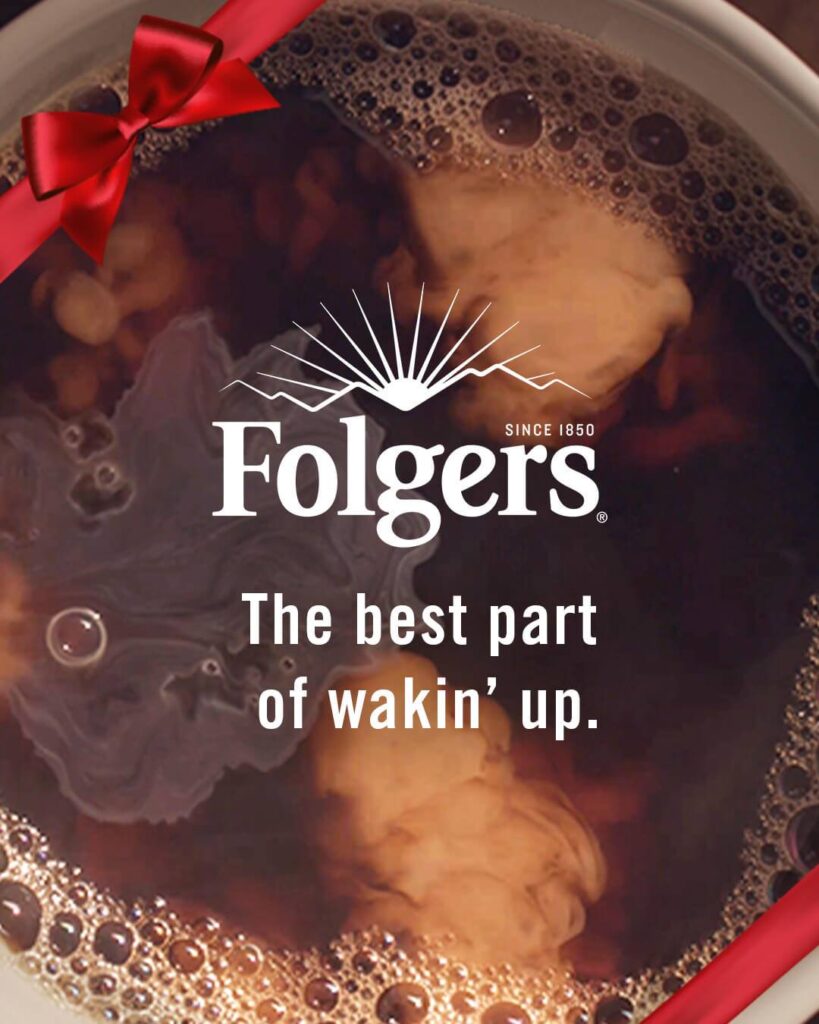
As coffee consumption became universal, brands shifted toward emotional positioning within daily routines. Folgers’ “The Best Part of Wakin’ Up” shows this transition, connecting coffee to family moments rather than product attributes.
Nescafe’s campaigns emphasized social connection: “It All Starts with a Nescafe” suggested coffee as conversation catalyst. This period introduced demographic targeting through slogan adaptation.
Young professionals heard “Fuel your ambition” messaging from brands like Seattle’s Best. Parents received “Family moments start here” variations. Senior consumers saw “Time-tested quality” positioning. The same base product supported multiple identity stories.
The Identity Phase (2000s-Present)
Contemporary coffee slogans function as personal statement vehicles rather than product descriptors. Starbucks’ “To inspire and nurture the human spirit” positions coffee consumption as self-actualization. Peet’s “Coffee Over Everything” appeals to enthusiasts who define themselves through coffee expertise. These messages assume coffee choice reflects personality and values.
Social media amplification changed slogan requirements fundamentally.
Phrases must work as hashtags, profile descriptions, and conversation starters. Dunkin’s “America Runs on Dunkin’” succeeds partly because it generates user-generated content: customers post morning routines tagged with the slogan.
This participatory element transforms advertising into community building.
Premium vs. Mass Market Differentiation
The voice gap between premium and mass market coffee brands widened significantly during this evolution. Mass market slogans emphasize accessibility: “America Runs on Dunkin’” celebrates everyman appeal.
Premium brands stress exclusivity: Lavazza’s “The Italian Way to Espresso” implies sophisticated taste requirement.
Pricing psychology drives much of this differentiation. When Starbucks charges $5 for drinks that Dunkin’ sells for $2, the premium brand must justify the difference through identity positioning rather than product c
laims. Hence slogans that promise lifestyle transformation rather than caffeine delivery.
What Coffee Slogans Teach About Consumer Psychology
Coffee slogans succeed because they address the psychological complexity of caffeine dependence without acknowledging it directly. Instead of saying “You need this drug,” effective coffee marketing says “You deserve this moment.”
This reframing transforms addiction into ritual, dependency into choice.
The Timing Strategy
The most memorable coffee slogans specify when consumption should occur, creating behavioral anchors that increase purchase frequency. Folgers owns the morning with “The Best Part of Wakin’ Up.”
Eight O’Clock Coffee claimed evening territory with “Wake up. It’s Eight O’Clock.” McCafe targets mid-day energy crashes with “Would you like a McCafe with that?”
This timing specificity works because coffee consumption follows predictable patterns driven by circadian rhythms and social schedules. By associating their brand with particular moments, companies create automatic purchase triggers.
The slogan becomes a mental alarm clock that promotes buying behavior.
The Social Permission Framework
Coffee slogans frequently provide social justification for individual indulgence. Nescafe’s “It All Starts with a Nescafe” frames coffee as productive investment rather than personal pleasure. Starbucks’ mission statement language elevates caffeine consumption to spiritual practice.
These messages help consumers rationalize spending on what is essentially a mild drug habit.
Research by behavioral economist Dan Ariely found that consumers justify discretionary purchases more easily when marketing provides external validation. Coffee slogans excel at this validation by connecting individual choice to broader cultural values: productivity, social connection, quality appreciation, or lifestyle aspiration.
The Authenticity Paradox
Premium coffee brands face a unique authenticity challenge: how to mass-produce artisanal experience.
Their slogans resolve this tension by emphasizing process over scale. Peet’s “Coffee Over Everything” suggests uncompro mising commitment. Lavazza’s “The Italian Way” implies traditional methods regardless of modern production realities.
This authenticity positioning becomes self-reinforcing through customer behavior. People who pay premium prices want to believe they’re purchasing superior products. The slogan provides linguistic evidence supporting that belief, creating cognitive consistency between price and perceived value.
Key Psychological Triggers in Successful Coffee Slogans
- Completion promise: “Good to the Last Drop” guarantees satisfaction through the entire consumption experience
- Identity reinforcement: “America Runs on Dunkin’” makes customers feel patriotic and hardworking
- Social proof: “It All Starts with a Nescafe” implies widespread adoption by successful people
- Expertise validation: “The Italian Way to Espresso” transfers cultural authority to product quality
- Ritual elevation: “The Best Part of Wakin’ Up” transforms routine into celebration
These psychological mechanisms explain why coffee slogans often outlast the executives who created them. They tap into fundamental human needs that transcend generational preferences or market trends.
Maxwell House’s century-long success with the same slogan demonstrates how well-crafted messaging becomes culturally embedded.
Starbucks vs. Nescafe vs. Dunkin’: Three Models of Coffee Communication
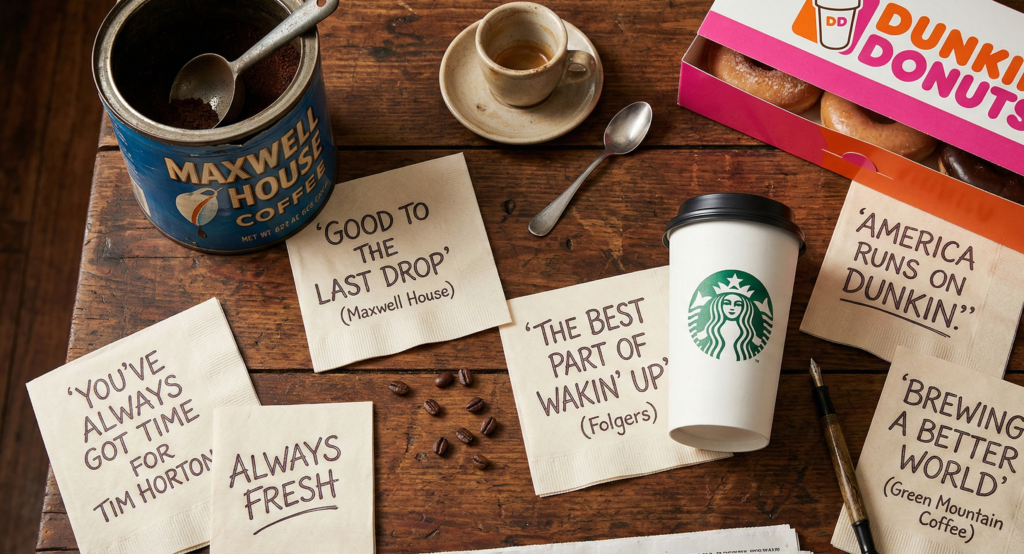
The world’s three largest coffee companies represent entirely different approaches to slogan strategy, reflecting distinct business models and customer relationships. Their messaging evolution reveals how global brands adapt core positioning across markets while maintaining brand consistency.
Starbucks: The Experience Premium
Starbucks deliberately avoids product-focused slogans, instead positioning coffee consumption as lifestyle choice. Their current mission statement “To inspire and nurture the human spirit” functions as extended slogan, appearing on packaging, store signage, and marketing materials.
This approach works because Starbucks locations serve as social spaces where messaging becomes environmental rather than promotional.
The strategy creates brand equity through aspiration rather than product claims. Customers pay premium prices partly because the brand promises identity enhancement.
Previous slogans like “Rewarding everyday moments” reinforced this positioning by suggesting that ordinary experiences become special through coffee choice.
Nescafe: The Global Connector
Nescafe operates in 180+ countries with localized slogan variations that maintain consistent themes: social connection, new beginnings, and shared experiences. “It All Starts with a Nescafe” works in English-speaking markets, while “Porque la vida es mejor cuando nos conectamos” emphasizes connection in Latin America. This flexibility allows Nescafe to adapt messaging to cultural values while maintaining global brand recognition.
Their slogans consistently position instant coffee as social catalyst rather than convenience product, directly addressing the quality perception gap between instant and fresh-brewed coffee.
Dunkin’: The Democratic Choice
Dunkin’s “America Runs on Dunkin’” represents populist positioning that celebrates accessibility over exclusivity. The slogan works because it makes every customer feel essential to national productivity. This democratic messaging contrasts sharply with Starbucks’ aspirational tone and Nescafe’s global sophistication.
Regional testing revealed that “America Runs on Dunkin’” increased purchase intent by 23% among target demographics compared to previous slogans like “Time to make the donuts.”
The current message succeeds because it transforms coffee consumption into patriotic act while emphasizing speed and efficiency over experience.
Strategic Comparison
- Target Customer: Starbucks targets lifestyle consumers; Nescafe serves global families; Dunkin’ appeals to working Americans
- Price Positioning: Starbucks justifies premium through experience; Nescafe emphasizes value through connection; Dunkin’ celebrates accessibility
- Message Consistency: Starbucks maintains global uniformity; Nescafe adapts locally; Dunkin’ focuses on domestic market
- Emotional Appeal: Starbucks promises transformation; Nescafe offers connection; Dunkin’ provides validation
These different approaches succeed because they address distinct consumer needs within the coffee market. Starbucks customers want identity expression, Nescafe buyers seek social connection, and Dunkin’ patrons value efficiency recognition.
The slogans work because they align messaging with customer psychology rather than product features.
Frequently Asked Questions
What makes a coffee slogan memorable and effective?
Effective coffee slogans combine emotional positioning with behavioral triggers, connecting the product to specific moments or feelings rather than just taste claims. The most successful ones like “Good to the Last Drop” and “The Best Part of Wakin’ Up” create mental associations between the brand and positive experiences.
They work because they address psychological needs (completion, ritual, social connection) while being linguistically memorable through rhythm, rhyme, or alliteration.
How do coffee brands adapt slogans across different markets?
Global coffee brands typically maintain core positioning themes while adapting language and cultural references for local markets. Nescafe, for example, emphasizes connection and new beginnings worldwide but uses different phrases: “It All Starts with a Nescafe” in English markets versus “Porque la vida es mejor cuando nos conectamos” in Latin America.
The emotional appeal remains consistent while execution reflects local values and language patterns.
Why do premium coffee brands avoid product-focused slogans?
Premium coffee brands focus on identity and experience rather than product attributes because they need to justify higher prices through emotional value rather than functional benefits. Starbucks’ “To inspire and nurture the human spirit” works better than taste claims because it positions coffee consumption as lifestyle choice.
When charging $5 for drinks that competitors sell for $2, brands must sell transformation rather than caffeine.
How has social media changed coffee slogan strategies?
Social media requires slogans to function as hashtags and user-generated content catalysts, not just advertising copy. Modern coffee slogans must be shareable, searchable, and conversation-worthy.
Dunkin’s “America Runs on Dunkin’” succeeds partly because customers use it in their own social posts about morning routines. The slogan becomes participatory rather than just promotional, extending reach through customer advocacy.
What role do coffee slogans play in the instant versus fresh coffee market divide?
Coffee slogans helped legitimize instant coffee by positioning it as convenience choice rather than inferior product. Nescafe’s campaigns in the 1960s transformed instant coffee from wartime substitute to modern convenience through slogans emphasizing social benefits over taste comparisons.
Today, instant coffee commands 34% of global consumption partly because effective slogans reframed the category positioning benefits rather than brewing method.