Pepsi Slogans: How Second Place Became a Superpower
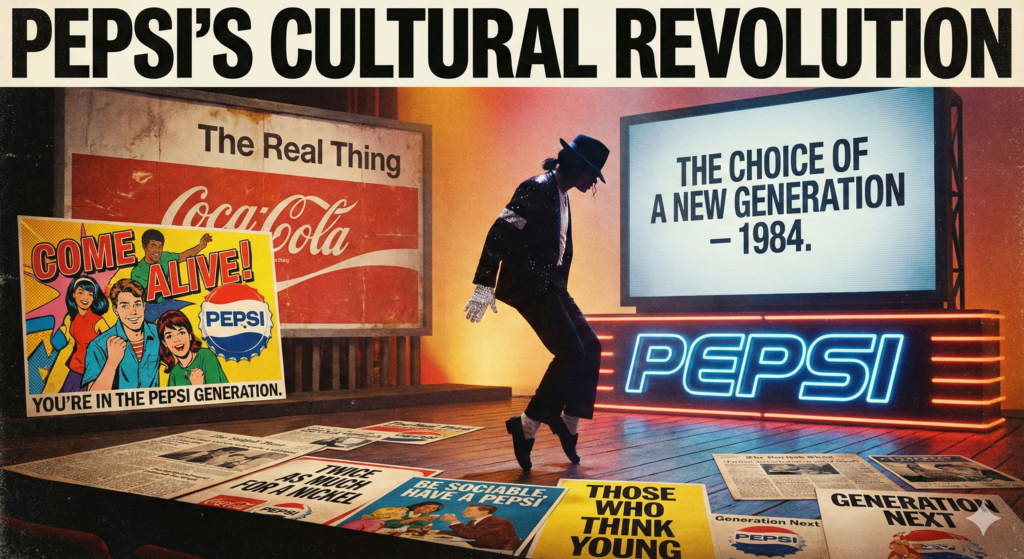
Michael Jackson moonwalking across a Pepsi commercial stage in 1984 wasn’t just entertainment. It was proof that the second-place cola brand had figured out something Coca-Cola hadn’t: when you can’t win on heritage, you win on culture. That’s what Pepsi taught us.
While Coke sold nostalgia and tradition, Pepsi’s slogans sold the future, positioning itself as the drink of choice for anyone who refused to settle for their parents’ preferences.
This positioning created one of marketing’s most successful challenger brand strategies. For over a century, Pepsi has used its taglines to frame market competition not as Pepsi versus Coke, but as tomorrow versus yesterday. The result? A brand that turned permanent second place into a cultural advantage, generating slogans that became generational rallying cries.
The evolution of Pepsi’s messaging reveals how challenger brands can thrive by embracing their underdog status rather than hiding from it. Every major slogan shift coincided with cultural moments when being different became more valuable than being first.
From the Great Depression’s “Twice as Much for a Nickel” to the 1960s “Pepsi Generation,” the brand consistently positioned itself as the smarter choice for people who thought independently.
History of Pepsi Slogans and Taglines
Pepsi’s slogan evolution spans twelve decades, reflecting America’s changing values, demographics, and cultural priorities. Each era brought distinct messaging strategies that responded to both market conditions and generational shifts.
| Year | Slogan/Tagline | Strategic Focus | Context |
|---|---|---|---|
| 1903 | Exhilarating, Invigorating, Aids Digestion | Health Benefits | Medicinal positioning from pharmacy origins |
| 1907 | Original Pure Food Drink | Purity/Quality | Food safety concerns era |
| 1913 | Drink Pepsi-Cola. It Will Satisfy You | Satisfaction | First satisfaction guarantee claim |
| 1934 | Twice as Much for a Nickel | Value | Great Depression response |
| 1950 | More Bounce to the Ounce | Energy | Post-WWII optimism |
| 1958 | Be Sociable, Have a Pepsi | Social Connection | Suburban social culture rise |
| 1961 | Now It’s Pepsi for Those Who Think Young | Youth Mindset | Baby Boomer emergence |
| 1963 | Come Alive! You’re in the Pepsi Generation | Generational Identity | 1960s youth rebellion |
| 1974 | Lipsmackin Thirstquenchin Ace Tastin… Pepsi | Attitude/Style | 1970s pop culture explosion |
| 1984 | The Choice of a New Generation | Youth Power | MTV generation launch |
| 1993 | Be Young, Have Fun, Drink Pepsi | Lifestyle | Gen X coming of age |
| 1997 | Generation Next | Future Focus | Internet age beginning |
| 1999 | Ask for More | Aspiration | Millennium optimism |
| 2001 | The Joy of Pepsi | Emotional Connection | Post-9/11 mood lift needed |
| 2013 | Live for Now | Present Moment | Social media immediacy culture |
| 2018 | That’s What I Like | Personal Preference | Customization/personalization era |
The strategic pattern reveals Pepsi’s consistent positioning as the progressive alternative. While Coca-Cola emphasized tradition and universality, Pepsi targeted specific demographics with messages about choice, youth, and cultural relevance.
The Pepsi Generation: How One Slogan Redefined Brand Competition
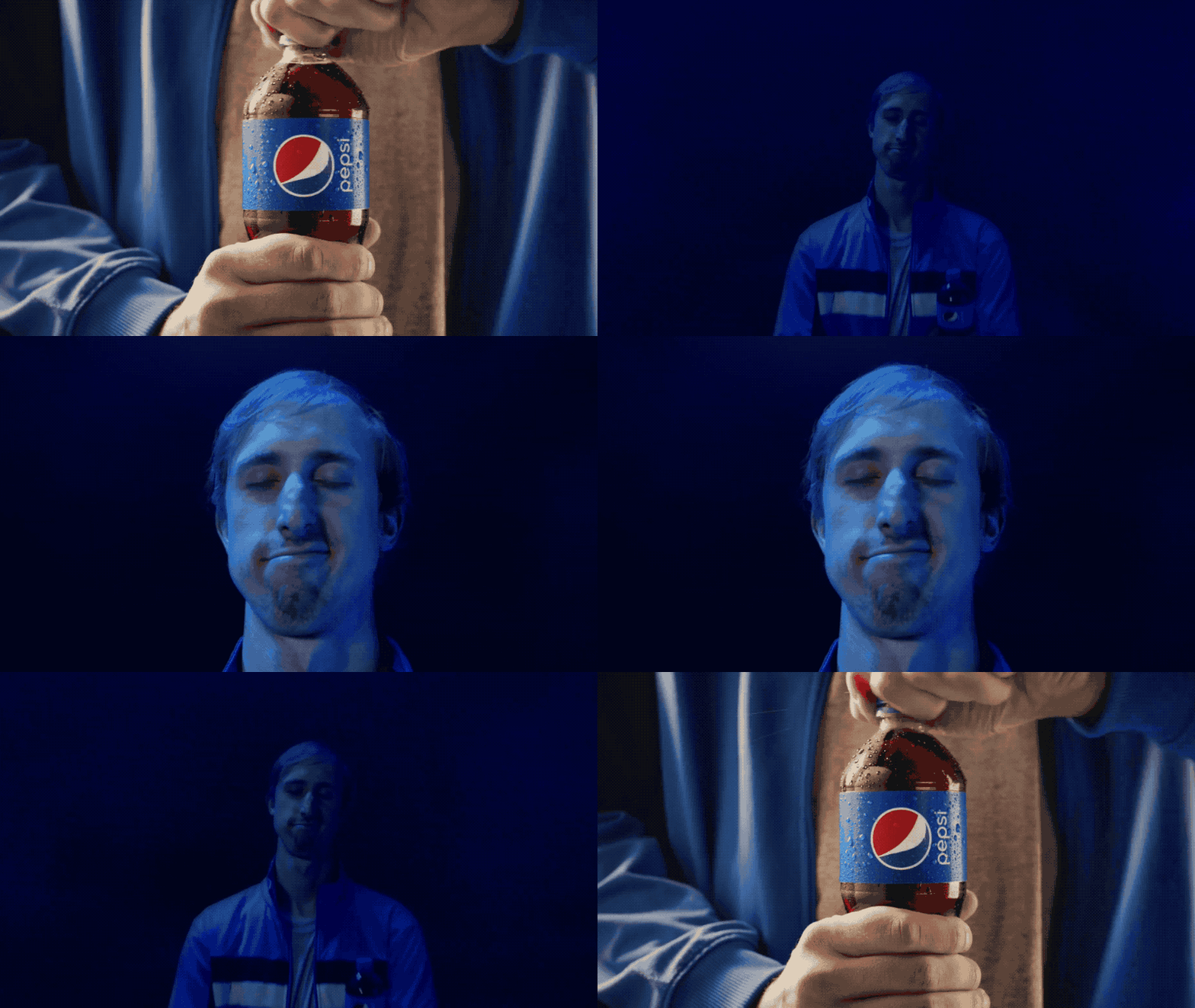
“Come Alive! You’re in the Pepsi Generation” launched in 1963 and fundamentally changed how challenger brands could compete. Rather than trying to match Coca-Cola’s broad appeal, Pepsi created an exclusive club that specifically excluded older, more conservative consumers.
The campaign originated from BBDO’s insight that Baby Boomers represented a massive, underserved demographic. Alan Pottasch, Pepsi’s advertising director from 1963 to 1994, convinced executives that generational marketing could be more powerful than universal messaging.
The strategy was risky because it deliberately alienated potential customers over 35, but it worked because it made younger consumers feel seen and understood.
Television commercials featured young adults in aspirational situations: college campuses, beach parties, sporting events, and social gatherings where Pepsi was the beverage of choice.
The casting was intentionally diverse for its era, reflecting Pepsi’s broader strategy to appeal to groups that Coca-Cola’s traditional Southern marketing had sometimes overlooked.
The “Pepsi Generation” concept became so culturally embedded that it influenced brand positioning across multiple industries. Car manufacturers began targeting “young drivers,” clothing brands focused on “youth fashion,” and even banks created “young professional” account packages.
Pepsi had demonstrated that demographic specificity could be more valuable than demographic breadth.
The Numbers Behind the Movement
Market research from the late 1960s showed that Pepsi gained significant share among 18-34 year-olds during the campaign, though overall market share remained behind Coca-Cola.
More importantly, the campaign established Pepsi’s long-term identity as the choice for people who saw themselves as forward-thinking, regardless of their actual age. This psychological positioning proved more durable than the demographic targeting that inspired it.
The slogan’s impact extended beyond sales metrics. It created cultural permission for other brands to abandon universal appeal in favor of targeted messaging. The success validated that being the preferred choice of a passionate segment could be more profitable than being the second choice of everyone.
Evolution of Brand Voice: From Health Tonic to Cultural Movement
Pepsi’s messaging evolution mirrors American cultural shifts more closely than perhaps any other consumer brand. The transformation from “Exhilarating, Invigorating, Aids Digestion” to “Live for Now” represents a century-long journey from functional benefits to emotional identity.
The Medicinal Years (1903-1920)
Creator Caleb Bradham’s pharmacy background influenced Pepsi’s earliest positioning. The name itself derived from dyspepsia (indigestion), and early slogans emphasized digestive and health benefits.
This medical positioning was common for early soft drinks, reflecting consumer skepticism about purely recreational beverages.
The health messaging worked because it provided rational justification for purchase. In an era when soft drinks were luxury items, functional benefits helped justify the expense. “Delicious and Healthful” combined pleasure with purpose, making Pepsi feel less frivolous than purely recreational drinks.
The Value Era (1930s-1940s)
The Great Depression forced Pepsi to pivot from health to value. “Twice as Much for a Nickel” became one of advertising’s most successful value propositions, helping Pepsi survive when many competitors failed. The 12-ounce bottle for a nickel (versus Coke’s 6.5-ounce bottle) created clear differentiation.
The “Nickel, Nickel” jingle became the first nationally broadcast advertising song, recorded in 55 languages and played at Carnegie Hall.
This musical approach foreshadowed Pepsi’s later celebrity partnerships, establishing entertainment as a core brand strategy decades before competitors adopted similar approaches.
The Youth Revolution (1960s-1980s)
The 1960s shift toward youth culture represented Pepsi’s boldest strategic decision. Instead of competing on product attributes, Pepsi began selling identity and aspiration. “Those Who Think Young” suggested that choosing Pepsi reflected personality rather than taste preference.
This period established Pepsi’s voice as confident, slightly rebellious, and culturally aware. The brand began featuring contemporary music, fashion, and social trends in advertising, positioning itself as an indicator of cultural relevance rather than just a beverage choice.
The Celebrity Era (1980s-Present)
Michael Jackson’s 1984 partnership launched Pepsi’s celebrity endorsement strategy, which became central to brand identity. Unlike traditional spokesperson relationships, Pepsi integrated celebrities into cultural moments, creating advertising that felt like entertainment rather than marketing.
The celebrity strategy reinforced Pepsi’s positioning as culturally connected and forward-thinking. By partnering with current stars rather than established icons, Pepsi maintained its association with emerging trends and generational change.
This approach required constant reinvention but created sustained differentiation from Coca-Cola’s more timeless messaging.
Marketing Lessons from Pepsi’s Slogan Strategy
Pepsi’s century-long messaging evolution offers crucial insights for challenger brands and established companies facing stronger competitors.
Embrace Your Position
Pepsi never tried to out-tradition Coca-Cola. Instead, it positioned being second as an advantage, suggesting that the leader was outdated rather than established. This reframing transformed market position from weakness to unique selling proposition.
Challenger brands often waste resources trying to match leader strengths rather than exploiting leader weaknesses. Pepsi’s success came from identifying what Coca-Cola couldn’t do (target youth without alienating older customers) rather than trying to match what it could do (broad appeal and heritage).
Cultural Timing Matters
Pepsi’s most successful campaigns aligned with broader cultural movements. “The Pepsi Generation” succeeded because it launched during the 1960s youth rebellion. “The Choice of a New Generation” worked because it coincided with MTV’s launch and the emergence of youth-driven media.
This timing wasn’t accidental. Pepsi invested heavily in cultural research and trend forecasting, allowing the brand to identify emerging movements before competitors. The key insight was that cultural movements create emotional urgency that traditional advertising cannot manufacture.
Consistency Enables Evolution
Despite frequent slogan changes, Pepsi maintained consistent strategic positioning around youth, choice, and cultural relevance. This consistency allowed dramatic tactical shifts without losing brand identity. Consumers understood that each new campaign represented the same core values expressed through contemporary language.
Many brands struggle with this balance, either changing too little (becoming stale) or too much (losing coherence). Pepsi demonstrated that brand equity can support significant creative evolution when the underlying position remains consistent.
Entertainment as Strategy
Pepsi pioneered using entertainment value as competitive advantage. From the “Nickel, Nickel” jingle to Michael Jackson partnerships, the brand created advertising that people actively wanted to consume. This approach generated earned media and cultural conversation beyond paid advertising placement.
The entertainment strategy worked because it aligned with Pepsi’s youth positioning. Young consumers were more likely to share entertaining content, amplifying campaign reach through word-of-mouth and social sharing before those terms existed.
Pepsi vs Coca-Cola: The Slogan Wars
The Pepsi-Coke rivalry produced marketing’s longest-running competitive dynamic, with each brand’s slogans responding to the other’s positioning strategies.
Coca-Cola’s messaging emphasized universality and timelessness. Slogans like “The Real Thing” (1969) and “I’d Like to Buy the World a Coke” (1971) promoted global unity and shared experience. This approach reinforced Coke’s position as the established, broadly accepted choice.
Pepsi consistently countered with exclusivity and contemporaneity. While Coke sang about bringing the world together, Pepsi celebrated generational differences. While Coke emphasized tradition, Pepsi promoted change and progress. This positioning strategy created a philosophical divide that went beyond taste preference.
The Cola Wars Peak
The competitive dynamic intensified during the 1980s “Cola Wars.” Coca-Cola’s “Coke Is It” (1982) attempted to reclaim youth positioning, but Pepsi’s “Choice of a New Generation” (1984) reinforced age-based differentiation. The rivalry reached its peak with the Pepsi Challenge taste tests, which used Pepsi’s brand awareness campaigns to question Coke’s product superiority claims.
The slogan competition revealed how challenger brands can shape market conversation. By consistently positioning choice as generational rather than personal, Pepsi forced Coca-Cola to respond on Pepsi’s terms rather than defending its own strengths. This dynamic helped both brands by creating cultural relevance and media attention that individual campaigns couldn’t generate.
Frequently Asked Questions
What is Pepsi’s most famous slogan?
“Come Alive! You’re in the Pepsi Generation” (1963) remains Pepsi’s most culturally significant slogan. It established the brand’s youth positioning and created the “Pepsi Generation” concept that influenced decades of subsequent campaigns. The slogan succeeded because it created exclusive group identity rather than just describing product benefits.
How often does Pepsi change its slogans?
Pepsi typically changes major slogans every 3-5 years, though some have lasted longer during particularly successful periods. The “Pepsi Generation” era spanned multiple variations from 1963-1984. Frequent changes reflect the brand’s strategy of staying culturally current rather than building long-term slogan recognition.
Why does Pepsi focus on young consumers?
Pepsi’s youth focus began as competitive necessity. Unable to match Coca-Cola’s broad appeal and heritage, Pepsi needed a differentiated target market. Young consumers offered the largest addressable segment that Coke hadn’t fully claimed. The strategy proved so successful that Pepsi maintained youth positioning even as its original target aged.
What was the “Lipsmackin” slogan about?
“Lipsmackin thirstquenchin ace tastin motivatin good buzzin cool talkin high walkin fast livin ever givin cool fizzin Pepsi” (1974) captured 1970s cultural style and attitude. Written by Dave Trott at BMP, the slogan combined multiple brand attributes into a rhythmic chant that became a cultural phenomenon. It demonstrated how creative execution could make product claims entertaining.
How do Pepsi’s slogans compare to Coca-Cola’s?
Pepsi’s slogans emphasize change, youth, and choice, while Coca-Cola’s focus on tradition, universality, and authenticity. Pepsi uses exclusionary language (“Generation,” “Choice,” “Think Young”) while Coke promotes inclusion (“Real Thing,” “World,” “Everyone”). This contrast reflects each brand’s competitive positioning and target market strategy.