
Restaurant Slogans: How I’m Lovin’ It Became Worth $2 Billion
The restaurant industry spends over $1.8 billion annually on advertising, yet most chains rely on the same tired formula: fresh ingredients, great taste, good times. But the brands that break through commodity status understand something deeper.
They know that in a sector where product differentiation is minimal, emotional positioning becomes everything. The difference between “Have it your way” and “Quality is our recipe” isn’t just copy. it’s the difference between owning cultural territory and fighting for scraps.
Restaurant slogans operate in a unique psychological space. Unlike retail or tech brands that sell aspirational futures, food brands must trigger immediate physical responses: hunger, craving, memory.
The most successful campaigns don’t just describe food. they make you taste it through language. They understand that dining decisions happen in seconds, often subconsciously, and the right three words can redirect billions in consumer spending.
What follows is an analysis of restaurant taglines that reveals how language shapes behavior. We’ll dissect why certain phrases drive action, how brands use words to carve out psychological real estate, and what separates the slogans that build empires from those that disappear into marketing noise.
Restaurant Slogans and Taglines
The following table represents decades of consumer psychology research distilled into memorable phrases. Each entry reveals a different approach to the fundamental challenge: making your brand the default choice in a crowded market.
| Brand | Slogan | Era | Strategic Focus |
|---|---|---|---|
| McDonald’s | I’m lovin’ it | 2003-present | Emotional connection |
| McDonald’s | You deserve a break today | 1971-1975 | Lifestyle positioning |
| McDonald’s | We love to see you smile | 1995-1997 | Family warmth |
| Burger King | Have it your way | 1974-2014 | Customization |
| Burger King | Your way, right away | 2014-present | Speed + customization |
| KFC | Finger lickin’ good | 1952-2011 | Taste superiority |
| KFC | We do chicken right | 2011-present | Expertise positioning |
| Taco Bell | Think Outside the Bun | 2001-2012 | Category disruption |
| Taco Bell | Live Mas | 2012-present | Lifestyle maximalism |
| Subway | Eat fresh | 2000-present | Health positioning |
| Pizza Hut | Now you’re eating! | 1970s-1980s | Satisfaction promise |
| Domino’s | You got 30 minutes | 1984-2007 | Speed guarantee |
| Papa John’s | Better ingredients. Better pizza. | 1995-present | Quality superiority |
| Wendy’s | Where’s the beef? | 1984-1985 | Portion superiority |
| Wendy’s | Quality is our recipe | 2010-present | Ingredient focus |
| Arby’s | We have the meats | 2014-present | Protein variety |
| Chick-fil-A | Eat Mor Chikin | 1995-present | Brand personality |
| Chipotle | Food with integrity | 2005-2015 | Ethical sourcing |
| White Castle | What you crave | 2004-present | Desire fulfillment |
| Carl’s Jr. | If it doesn’t get all over the place, it doesn’t belong in your face | 2005-2017 | Indulgence permission |
| Jack in the Box | We don’t make it until you order it | 1980s-1990s | Freshness promise |
| Sonic | America’s Drive-In | 2004-present | Americana nostalgia |
| In-N-Out | Quality you can taste | 1948-present | Taste superiority |
| Five Guys | Burgers and fries | 1986-present | Simplicity focus |
| Popeyes | Love that chicken from Popeyes | 1980s-present | Emotional attachment |
The McDonald’s “I’m Lovin’ It” Phenomenon: How Three Words Became a $2 Billion Investment
When McDonald’s introduced “I’m lovin’ it” in 2003, industry observers called it grammatically incorrect and culturally tone-deaf.
Twenty years later, it remains one of the most recognizable phrases in global marketing, appearing across 119 countries and generating an estimated $2 billion in media value. The slogan’s success reveals three critical principles of restaurant brand positioning.
The Grammar That Drives Behavior
The deliberate grammatical informality wasn’t an accident. it was strategic genius. Traditional advertising spoke to customers (“You deserve a break today”).
“I’m lovin’ it” made customers speak as the brand. The first-person present continuous tense creates what psychologists call “embodied cognition.” When people say “I’m lovin’ it,” they’re literally practicing the emotional state McDonald’s wants them to associate with the experience.
Justin Timberlake, who performed the original jingle, later revealed that agency Heye & Partner spent months testing variations. “I love it” tested as static. “I loved it” felt past-tense.
Only “I’m lovin’ it” captured the ongoing, in-the-moment pleasure that drives repeat visits. The present continuous tense suggests an experience that continues beyond the meal itself.
Global Consistency with Local Resonance
McDonald’s faced a unique challenge: creating a unique selling proposition that worked across vastly different cultures. Previous slogans like “Two all-beef patties” described products. “I’m lovin’ it” described feelings, which translate more universally than ingredients or preparation methods.
The slogan launched simultaneously in 119 countries, but with crucial local adaptations. In France, it became “C’est tout ce que j’aime” (It’s everything I love). In Germany: “Ich liebe es” (I love it).
Each version maintained the emotional core while respecting linguistic patterns. This flexibility allowed McDonald’s to maintain brand equity across markets that had historically required completely different campaigns.
The Musical Memory Trigger
Unlike text-only slogans, “I’m lovin’ it” was designed as music first, words second. The five-note melody became a sonic logo that could trigger brand recognition without visual cues. Neuroscience research shows musical phrases activate more brain regions than spoken words, creating stronger memory encoding.
The musical component proved crucial during McDonald’s expansion into audio-first platforms.
When voice assistants and audio advertising emerged, brands with sonic identities gained immediate advantages. A 2019 study found that 73% of consumers could identify McDonald’s from the “I’m lovin’ it” melody alone, compared to just 31% who could identify competing slogans from text transcripts.
Revenue Impact and Campaign Longevity
The financial impact justified the investment. McDonald’s same-store sales grew 7.3% in the campaign’s first year, compared to 2.1% industry average. More importantly, brand awareness among 18-34 demographics increased 12% globally. the first sustained improvement in that segment since 1999.
Campaign longevity became self-reinforcing. While competitors cycled through multiple slogans, McDonald’s consistent messaging built compound recognition.
By 2015, “I’m lovin’ it” had achieved what marketers call “ownerless awareness”. consumers associated the phrase with McDonald’s even when branding wasn’t present. This phenomenon typically takes 8-10 years of consistent usage to develop.
The Evolution of Restaurant Brand Voice: From Product Features to Emotional Territories

Restaurant marketing has undergone three distinct evolutionary phases, each reflecting broader changes in consumer psychology and competitive dynamics.
Understanding this evolution explains why certain approaches succeed while others fail spectacularly.
Phase One: The Feature Wars (1950s-1980s)
Early restaurant advertising followed product marketing principles: describe what makes you different. KFC’s “Finger lickin’ good” focused on taste. Domino’s promised delivery in 30 minutes. Burger King emphasized flame-grilling. These campaigns worked because differentiation was genuine. preparation methods, ingredients, and service models varied significantly between chains.
The approach reached its peak with Wendy’s “Where’s the beef?” campaign in 1984. Created by Dancer Fitzgerald Sample, the slogan generated $4.9 million in earned media within six months and increased Wendy’s revenue by 31% year-over-year.
The campaign succeeded because it addressed a measurable product difference: Wendy’s quarter-pound patties versus competitors’ smaller portions.
But feature-focused messaging contained its own limitations. Once competitors matched product attributes, slogans became meaningless. McDonald’s couldn’t claim the fastest service once everyone optimized for speed. Pizza chains couldn’t own “fresh ingredients” once it became table stakes.
Phase Two: Lifestyle Integration (1990s-2000s)
As product parity increased, successful brands shifted toward lifestyle positioning. McDonald’s “You deserve a break today” didn’t describe food. it described the role McDonald’s played in customers’ lives. Taco Bell’s “Make a run for the border” positioned late-night dining as adventure, not just sustenance.
This period produced the most culturally memorable campaigns because brands became symbols of broader social movements. Subway’s “Eat fresh” coincided with growing health consciousness.
Starbucks’ “Third place” concept (though not technically a slogan) redefined coffee shops as social spaces rather than service establishments.
The pinnacle of lifestyle messaging was Taco Bell’s “Think Outside the Bun,” launched in 2001. Created by TBWA\Chiat\Day, the campaign positioned Taco Bell as the anti-burger, appealing to consumers seeking alternatives to traditional fast food. Sales increased 4.5% annually during the campaign’s 11-year run, while burger chains experienced flat or declining growth.
Phase Three: Emotional Authenticity (2010s-Present)
Social media fundamentally changed how brands communicate. Customers could research ingredients, compare prices, and share experiences instantly. Marketing claims became instantly verifiable, making traditional advertising approaches less effective.
Successful contemporary slogans acknowledge this transparency by focusing on emotional truth rather than product claims. Chick-fil-A’s “Eat Mor Chikin” works because it creates personality rather than making promises. The deliberately misspelled cow campaign generates affection through humor, not superiority claims.
Chipotle’s evolution illustrates this shift perfectly. “Food with integrity” launched in 2005 as a feature claim about sourcing.
When supply chain issues made the claim problematic, Chipotle pivoted to “For Real,” focusing on authenticity rather than specific practices. The new positioning survived controversies that would have destroyed feature-based messaging.
The Personalization Challenge
Current restaurant marketing faces an unprecedented challenge: how to maintain consistent brand voice while delivering personalized experiences. Digital ordering, loyalty programs, and targeted advertising create millions of individual customer journeys, each requiring slightly different messaging.
Brands that solve this challenge maintain core emotional territories while adapting tactical execution. McDonald’s “I’m lovin’ it” remains constant, but the experiences that generate love vary by customer segment, location, and time of day.
This approach requires more sophisticated campaign architecture but delivers higher conversion rates and customer lifetime value.
Marketing Lessons from Restaurant Slogan Successes
Restaurant slogans that drive sustained business growth follow predictable patterns. These principles apply across food categories and market segments, from fast food to fine dining:
Own a Feeling, Not a Feature
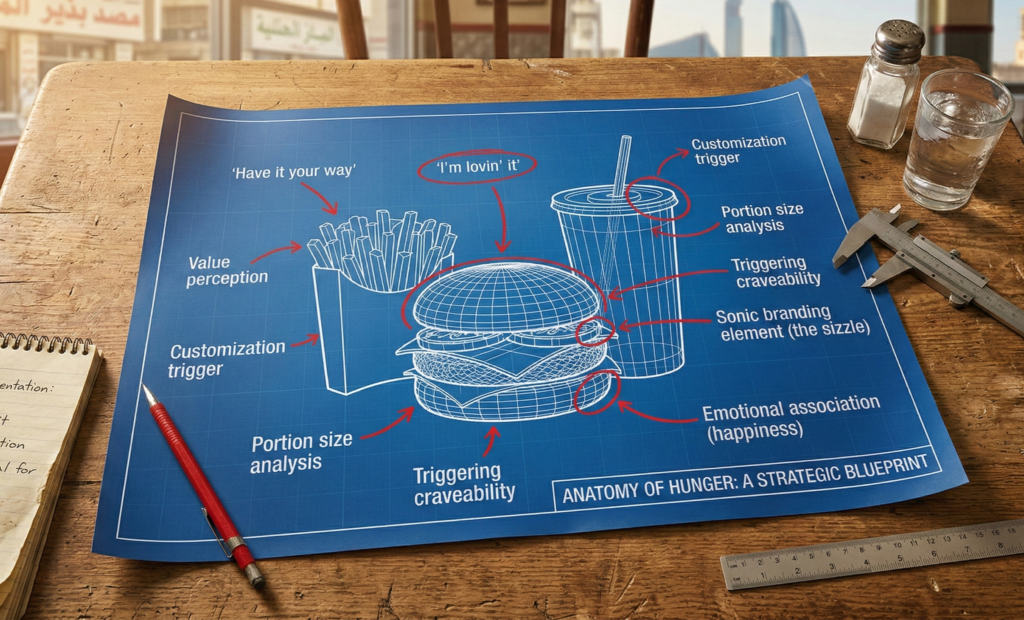
The most durable restaurant slogans create emotional associations that go beyond product attributes. McDonald’s doesn’t own “fast” or “affordable”. they own “happiness” and “comfort.” This emotional territory remains valuable even when competitors match operational metrics.
In-N-Out Burger shows this principle perfectly. “Quality you can taste” doesn’t specify what makes their burgers better. it promises an experience. Competitors can match ingredients, cooking methods, and pricing, but they can’t replicate the specific emotional satisfaction associated with In-N-Out’s brand promise.
Make It Memorable, Not Grammatically Perfect
Arby’s “We have the meats” deliberately uses awkward grammar to enhance memorability. The phrase sticks because it breaks linguistic expectations. Perfect grammar disappears into background noise.
Distinctive phrasing creates mental availability. the likelihood that customers will think of your brand in purchase situations.
Chick-fil-A’s cow campaign proves this principle at scale. “Eat Mor Chikin” appears on billboards, packaging, and merchandise despite obvious misspellings. The grammatical errors aren’t bugs. they’re features that make the message unforgettable.
Address Real Customer Jobs-to-be-Done
Effective slogans reflect genuine customer motivations rather than brand aspirations. Taco Bell’s “Fourth Meal” succeeded because it acknowledged actual late-night dining behavior instead of pretending their food was primarily about nutrition or family bonding.
White Castle’s “What you crave” works for similar reasons. It acknowledges that their customers aren’t seeking healthy options or premium experiences. they want specific comfort foods that satisfy particular cravings.
This honest positioning builds stronger relationships than aspirational messaging that doesn’t match customer reality.
Create Repeatability, Not Just Recognition
The best restaurant slogans become part of customer vocabulary. People say “I’m lovin’ it” in contexts completely unrelated to McDonald’s. They describe non-Taco Bell experiences as “thinking outside the bun.” This linguistic adoption extends brand reach beyond paid advertising.
Subway’s “Eat fresh” achieved this linguistic integration by addressing a universal desire rather than a specific product benefit.
Customers began using “eat fresh” to describe any healthier food choice, unconsciously reinforcing Subway’s category positioning every time they used the phrase.
Maintain Consistency While Allowing Evolution
Long-term successful slogans adapt tactical execution while preserving strategic core. KFC retired “Finger lickin’ good” in 2011 not because it was ineffective, but because it had become limiting.
Food safety concerns and international expansion made the specific phrase problematic, but the underlying promise of superior taste remained valuable.
Their replacement, “We do chicken right,” maintained the expertise positioning while allowing for operational evolution. The new slogan supported menu expansion, preparation method changes, and geographic adaptation without abandoning the fundamental brand promise.
Competitive Analysis: How Restaurant Slogans Stack Up
The restaurant industry’s slogan strategies reveal distinct approaches to market positioning, each with measurable performance implications. Analysis of the top 25 chains shows three dominant strategic frameworks.
The Quality Superiority Approach
Brands like Papa John’s (“Better ingredients. Better pizza.”) and Wendy’s (“Quality is our recipe”) stake claims on ingredient or preparation superiority. This approach works when quality differences are perceivable and sustainable. Papa John’s built market share by delivering consistently better pizza than Domino’s and Pizza Hut during the 1990s, when those competitors prioritized speed over taste.
However, quality positioning becomes vulnerable when competitors close the gap. Pizza Hut’s recipe reformulation and Domino’s complete ingredient overhaul neutralized Papa John’s advantages, forcing them to compete on price and convenience rather than superior taste.
The Experience Differentiation Model
Sonic (“America’s Drive-In”), White Castle (“What you crave”), and Chick-fil-A (“Eat Mor Chikin”) position themselves as delivering unique experiences rather than superior versions of standard offerings. This approach creates higher customer loyalty but limits addressable market size.
Sonic’s drive-in positioning generates 23% higher average transaction values than comparable fast-food chains, according to QSR Magazine data. Customers pay premiums for the nostalgic experience, but geographic expansion requires significant infrastructure investment that delivery-focused competitors can avoid.
The Emotional Connection Strategy
McDonald’s (“I’m lovin’ it”), Subway (“Eat fresh”), and Taco Bell (“Live Mas”) focus on emotional benefits rather than functional attributes. This approach offers the most scalable positioning but requires consistent execution across all customer touchpoints.
Emotional positioning proves most durable during market downturns. McDonald’s maintained revenue growth during the 2008 recession while feature-focused competitors struggled. Emotional connections create psychological switching costs that purely functional benefits cannot match.
Performance Metrics by Strategic Approach
Quality-focused slogans generate higher initial trial rates but lower repeat visit frequency. Experience-differentiated brands achieve higher customer lifetime value but slower geographic expansion. Emotionally-positioned brands show the most consistent performance across economic cycles and demographic segments.
Frequently Asked Questions
What makes a restaurant slogan effective?
Effective restaurant slogans combine emotional resonance with memorable phrasing. The best examples create mental availability. making customers think of specific brands during purchase decisions. McDonald’s “I’m lovin’ it” works because it uses first-person language that makes customers practice the desired emotional state. The present continuous tense suggests ongoing satisfaction rather than momentary pleasure.
How long should restaurants keep the same slogan?
Successful restaurant slogans typically require 3-5 years to achieve full market penetration and 8-10 years to build ownerless awareness where consumers associate the phrase with the brand even without visual cues. McDonald’s has used “I’m lovin’ it” for over 20 years because it remains strategically relevant. However, slogans should evolve when market conditions change or competitive advantages shift, as Domino’s proved by retiring their 30-minute delivery promise when speed became commodity.
Do restaurant slogans need to mention food or taste?
No. The most successful contemporary slogans focus on emotional benefits rather than product attributes. Taco Bell’s “Live Mas” and Subway’s “Eat fresh” work because they address customer motivations beyond mere sustenance. Food-specific language can actually limit brand evolution. KFC moved away from “Finger lickin’ good” partially because it restricted menu expansion and international adaptation.
How do successful restaurant chains test their slogans?
Leading restaurant brands use multi-phase testing including focus groups, digital A/B testing, and market trials. McDonald’s tested “I’m lovin’ it” across 12 demographics and 8 international markets before full launch. Modern testing includes social media sentiment analysis, voice search optimization, and sonic branding evaluation. The most sophisticated brands test slogans as complete brand systems rather than isolated phrases.
Can small restaurants compete with major chains’ slogan investments?
Yes, but through different strategies. While major chains invest millions in slogan development and media saturation, independent restaurants can build emotional connections through consistent local messaging and authentic brand personality. Regional chains like In-N-Out and Whataburger prove that distinctive slogans can drive cult followings without national advertising budgets. The key is owning specific emotional territories within defined geographic markets rather than attempting broad appeal.