Zara produces over 11,000 distinct items per year while most competitors manage 2,000 to 4,000. That speed is not a marketing gimmick. It is the direct result of a business model that integrates design, manufacturing, and distribution under one roof.
This analysis breaks down every layer of the Zara business model, from vertical integration and supply chain mechanics to the scarcity-driven marketing strategy that spends almost nothing on advertising. We compare Zara to Shein, H&M, and Uniqlo, include an up-to-date Business Model Canvas, and examine the sustainability challenges threatening this model’s future.
What Makes Zara’s Business Model Unique?
Zara, the flagship brand of Spanish conglomerate Inditex, operates on a model that contradicts conventional fashion retail wisdom. Traditional retailers forecast trends 6 to 12 months ahead, produce in bulk, and accept 30% to 40% inventory markdowns. Zara does the opposite.
The company produces small batches, tests them in stores, and scales only what sells. This approach reduces overproduction, minimizes markdowns to roughly 15% to 20% of inventory compared to the industry average of 30% to 40%, and keeps customers returning to stores frequently because the merchandise changes every two weeks.
Amancio Ortega, Inditex’s reclusive founder, built this system in the 1970s by studying how fashion supply chains wasted time and money.
How Zara’s Vertical Integration Works
Vertical integration is the backbone of Zara’s speed advantage. Most fashion brands outsource manufacturing to contractors in Bangladesh, Vietnam, or China. Zara manufactures approximately 50% to 60% of its products in-house or through closely controlled workshops in Spain, Portugal, Turkey, and Morocco.
Design to Store in 3 Weeks
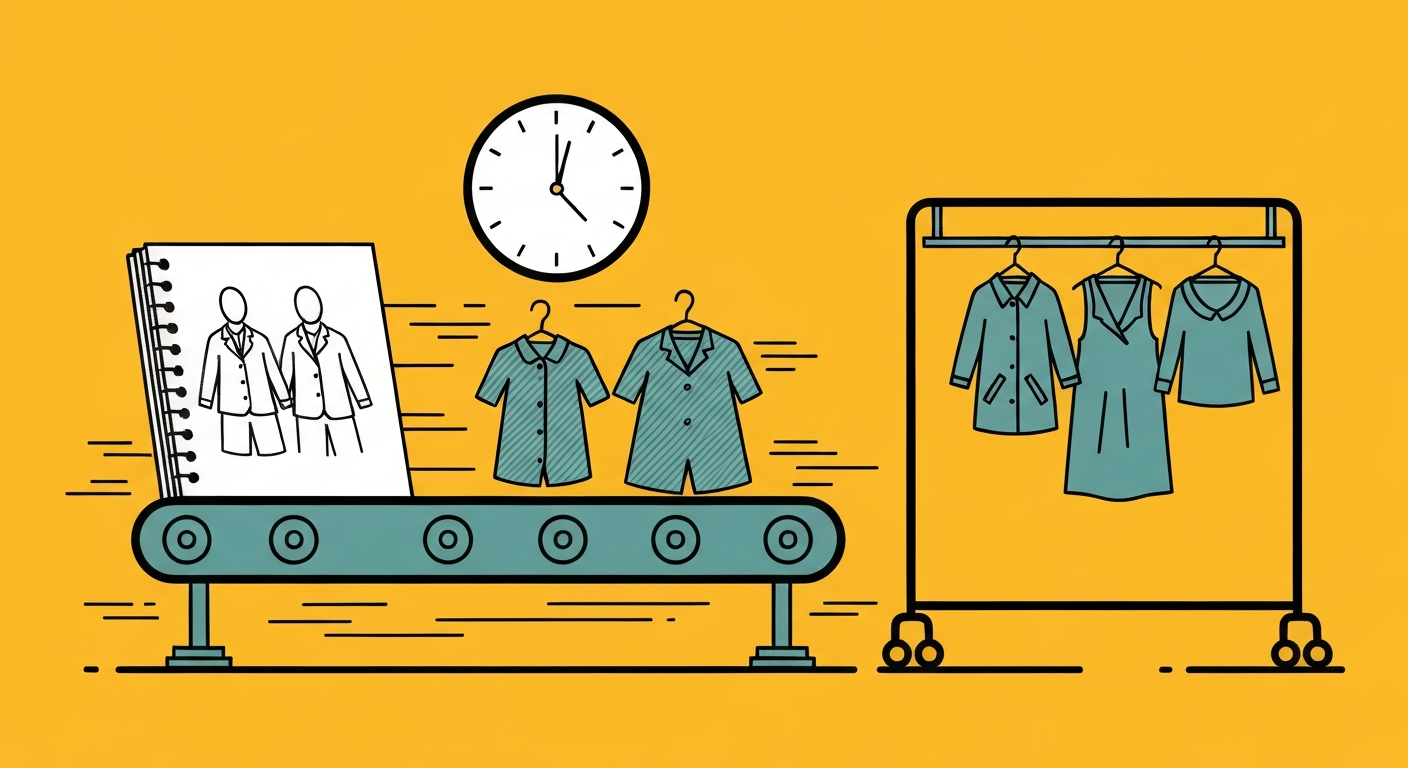
Zara’s design team of over 700 professionals monitors runway shows, street fashion, social media trends, and real-time store sales data. When a trend emerges, the team can create a new design, produce a sample, manufacture a test batch, and ship it to stores in as few as 15 days. H&M’s comparable process takes roughly 5 to 6 months.
This compression means Zara reacts to demand rather than predicting it.
Near-Shoring vs Offshoring
Zara’s near-shore production strategy prioritizes proximity over unit cost. Factories in Spain, Portugal, Turkey, and Morocco cost more per garment than factories in Southeast Asia. The tradeoff is speed. A shipment from a Galician factory reaches any European store within 48 hours. A shipment from Bangladesh takes three to four weeks.
For trend-sensitive items where timing determines sellthrough, the higher production cost is recovered through fewer markdowns and faster inventory turns.
In-House Manufacturing
Inditex operates its own fabric cutting, dyeing, and finishing facilities near its headquarters in Arteixo, Spain. Raw fabric is dyed after production begins, not before, allowing the company to adapt colors to real-time demand signals. This postponement strategy is a core competitive advantage that competitors have struggled to replicate.
Zara’s Supply Chain Strategy
The supply chain is where Zara’s business model delivers its greatest competitive separation.
12 Inventory Turns Per Year
Zara turns its inventory approximately 12 times per year compared to an industry average of 3 to 4 turns. Higher inventory turns mean less capital locked in unsold stock, lower storage costs, and reduced risk of obsolescence. For a fashion retailer, inventory velocity is arguably more important than gross margin.
RFID and Data-Driven Restocking
Every Zara garment carries an RFID chip that tracks movement from warehouse to fitting room. Store managers see exactly which items sell within hours of hitting the floor. This data flows to headquarters in real time, where algorithms determine restocking quantities and new production orders.
The RFID system also reveals what customers try on but do not buy, signaling fit or pricing problems faster than sales data alone. Inditex completed its RFID technology rollout across all brands between 2014 and 2016, purchasing 500 million RFID chips for the implementation.
This level of data granularity gives Zara a decision speed advantage that pure-play e-commerce competitors achieve with click data but traditional retailers lack entirely.
Limited Production Runs and Scarcity
Zara deliberately produces less than projected demand. Shelves are intentionally under-stocked to create a sense of urgency. Customers learn that if they see something they like, they must buy it immediately because it may not be there next week.
This scarcity principle generates repeat visits. Zara customers visit stores an average of 17 times per year compared to 3 to 4 visits for other fashion retailers.
Zara’s Marketing Strategy: Minimal Advertising, Maximum Impact
Zara spends roughly 0.3% of revenue on advertising compared to 3% to 4% for competitors like H&M and Gap. This near-zero advertising budget is not frugality. It is a strategic choice built on the premise that product freshness and store experience are more effective marketing tools than paid media.
Store Location as Marketing
Zara invests in prime retail locations on the world’s most expensive shopping streets. Fifth Avenue, Oxford Street, the Champs-Elysees. The stores themselves function as billboards. Large glass facades, minimalist interiors, and frequent visual merchandising updates communicate brand positioning more effectively than a television commercial.
Each store receives new merchandise twice per week, giving customers a reason to return that no ad campaign can replicate.
Word-of-Mouth and Scarcity-Driven Demand
The limited production run strategy turns every purchase into a social signal. When a Zara item appears on Instagram, followers know it will sell out quickly. This organic urgency generates more engagement than paid influencer campaigns.
Zara’s social media presence focuses on curated lookbooks and new collection announcements rather than paid promotions. The brand’s Instagram account has over 62 million followers, built almost entirely on product-driven content rather than paid acquisition.
Zara’s Business Model Canvas
The Business Model Canvas framework maps the nine building blocks of Zara’s competitive architecture.
| Canvas Element | Zara’s Approach |
|---|---|
| Key Partners | Near-shore manufacturers (Spain, Portugal, Morocco, Turkey), fabric suppliers, logistics providers |
| Key Activities | Trend detection, rapid design, in-house production, RFID inventory management, biweekly store restocking |
| Key Resources | 700+ designers, owned factories, centralized logistics hub in Arteixo, proprietary RFID system |
| Value Proposition | Runway-inspired fashion at affordable prices, refreshed biweekly, with scarcity-driven exclusivity |
| Customer Relationships | Transactional with loyalty driven by product freshness, not points programs |
| Channels | 2,000+ owned stores in prime locations, Zara.com e-commerce |
| Customer Segments | Fashion-conscious consumers aged 18-40, mid-income, trend-driven |
| Cost Structure | Higher production costs (near-shoring), prime real estate, minimal advertising spend |
| Revenue Streams | Retail sales (stores + e-commerce), with growing online share post-COVID |
Zara vs Competitors
Competitive context reveals where Zara’s model excels and where it faces pressure. The table below compares Zara against its four primary competitors across the metrics that define fast fashion success.
| Metric | Zara (Inditex) | H&M | Shein | Uniqlo | Gap |
|---|---|---|---|---|---|
| Revenue (2024) | ~$40B (Inditex) | ~$23B | ~$38B | ~$21B | ~$15B |
| Design-to-Store | 2-3 weeks | 5-6 months | 5-7 days | 6-12 months | 6-10 months |
| New Items/Year | 11,000+ | 12,000-16,000 | 300,000+ | 1,000 | 4,000 |
| Manufacturing | 50-60% in-house | Fully outsourced | Fully outsourced (China) | Partner factories (Asia) | Fully outsourced |
| Ad Spend (% Rev) | ~0.3% | ~3.5% | Heavy digital spend | ~3% | ~4% |
| Inventory Turns | ~12x/year | ~3-4x/year | ~12x/year (30-day cycle) | ~3x/year | ~4x/year |
| Sustainability Focus | Growing (Join Life) | Strong (Conscious) | Minimal | Strong (LifeWear) | Moderate |
The most significant competitive threat is Shein. The Chinese ultra-fast fashion platform out-speeds Zara on production cycles and vastly exceeds it on product variety. Shein’s digital-only model eliminates store costs entirely.
Where Zara still wins is perceived quality and brand equity. Shein competes on price and novelty. Zara competes on design credibility and the in-store experience.
Zara’s Financial Performance and Key Metrics
Inditex reported revenue of approximately EUR 38.6 billion in fiscal year 2024, with Zara contributing roughly 72% of that total. The group’s net profit margin reached approximately 15%, significantly above the fashion retail industry average.
Three financial metrics stand out. First, gross margin consistently above 55% despite near-shore production costs. Second, operating cash flow strong enough to fund store expansion without significant debt. Third, return on invested capital that signals every euro deployed in stores and supply chain generates outsized returns.
E-commerce now accounts for roughly 26% of Inditex sales, up from 14% pre-COVID.
Challenges Facing Zara’s Business Model
No business model is immune to disruption, and Zara faces two structural threats that could erode its competitive position within the next decade.
Sustainability and Fast Fashion Criticism
The environmental cost of fast fashion is becoming a regulatory and reputational risk. The European Parliament estimates that the fashion industry is responsible for 10% of global carbon emissions. Zara’s business model, which incentivizes frequent purchasing and rapid garment replacement, sits directly in the crosshairs of this criticism.
Inditex has launched its “Join Life” sustainability line and committed to using 100% sustainable cotton, linen, and polyester by 2025. Critics argue these initiatives amount to greenwashing when the core business model still depends on producing over 11,000 new items per year.
The EU’s proposed textile waste regulations could fundamentally increase production costs for fast fashion brands.
Shein and Ultra-Fast Fashion Threat
Shein’s model is Zara’s model taken to its logical extreme: faster, cheaper, with no physical stores. Shein can test a design with a batch of 50 to 100 units, measure online demand within 72 hours, and scale production to thousands of units within days. This digital-first approach reaches Gen Z consumers who increasingly shop on mobile.
Zara’s response has been to accelerate its own e-commerce capabilities and lean into quality differentiation. The physical store network, long a strength, could become a liability if foot traffic continues shifting online among younger demographics.
Key Lessons from Zara’s Strategy
Five strategic principles from Zara’s business model apply well beyond fashion retail.
- Speed beats prediction. Reacting to real demand data costs less and reduces risk compared to forecasting 12 months ahead.
- Vertical integration enables differentiation. Owning production gives Zara control over quality, timing, and cost that outsourcing-dependent competitors cannot match.
- Scarcity drives demand. Producing less than projected demand creates urgency and reduces markdowns simultaneously.
- Stores are media. Zara’s prime retail locations generate more brand awareness than traditional advertising at a fraction of the incremental cost.
- Data drives decisions. RFID-powered real-time inventory data replaces intuition with evidence at every level of the supply chain.
Frequently Asked Questions
What type of business model does Zara use?
Zara uses a vertically integrated fast fashion model. The company controls design, manufacturing, logistics, and retail under one corporate structure. This integration enables 2 to 3 week design-to-store cycles, which is 5 to 10 times faster than most competitors.
How does Zara keep prices low with in-house manufacturing?
Zara offsets higher per-unit production costs through faster inventory turns and lower markdown rates. Producing small batches and scaling only what sells means less wasted inventory. The savings from avoiding 30% to 40% industry-standard markdowns more than cover the higher manufacturing cost per garment.
Why does Zara spend so little on advertising?
Zara invests in prime store locations and biweekly product refreshes instead of traditional advertising. The stores serve as physical brand experiences. Product scarcity generates organic social media buzz. This model has proven more effective at driving repeat visits than paid campaigns, at roughly one-tenth the cost as a percentage of revenue.
Is Zara’s business model sustainable?
Environmentally, Zara faces growing pressure. The fast fashion model incentivizes frequent purchasing, which conflicts with sustainability goals. Inditex has committed to sustainable fabric sourcing and recycling programs, but the core tension between fast fashion speed and environmental responsibility remains unresolved.
How is Shein different from Zara?
Shein is digital-only with no physical stores, produces 300,000+ items per year compared to Zara’s 11,000, and operates on even shorter production cycles of 5 to 7 days. Shein competes primarily on price and variety. Zara competes on design quality, brand credibility, and the in-store experience. Shein’s model produces more waste and faces greater regulatory risk.
For a complementary perspective on Zara’s competitive position, explore our SWOT analysis of Zara or see how other brands build competitive moats in our guide to market positioning strategy.