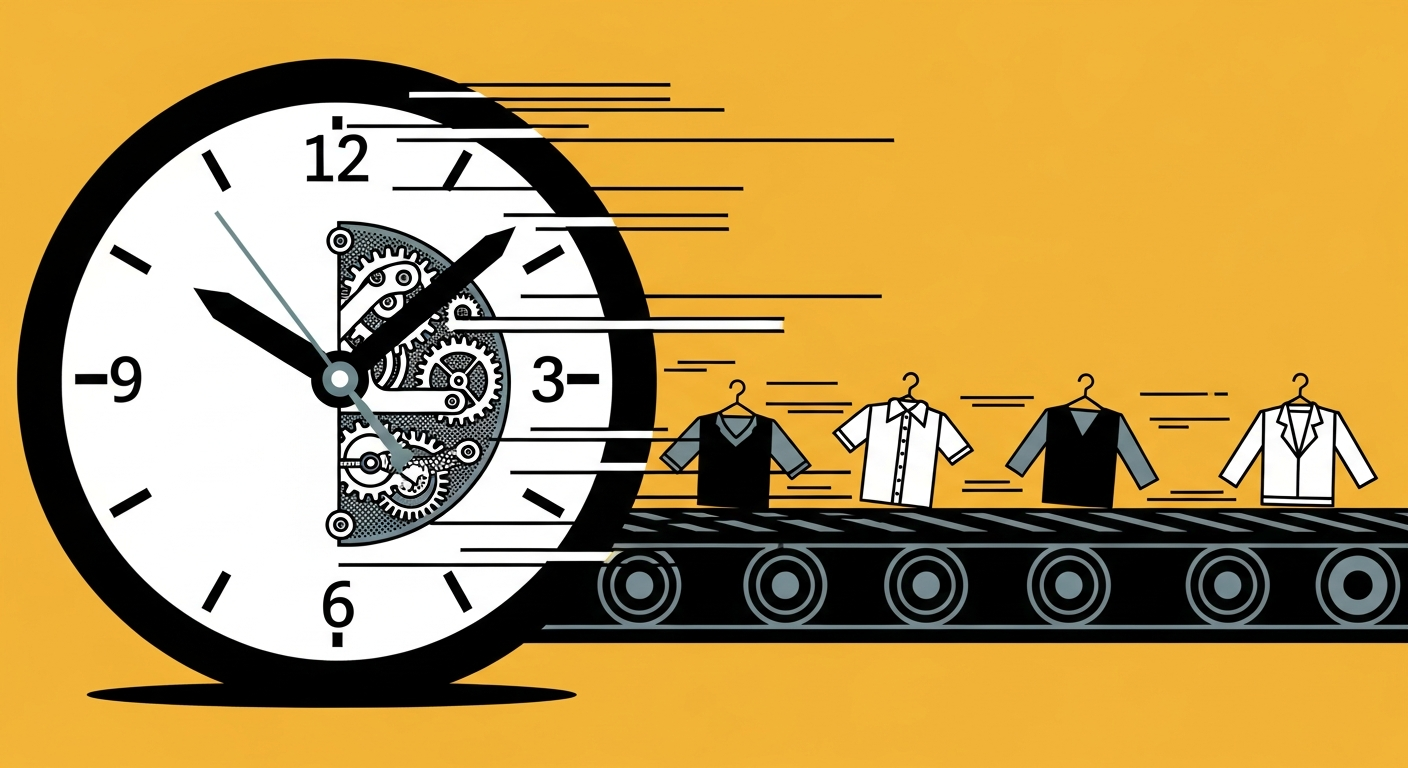
 marketing strategy breakdown showing store front and brand positioning” width=”1200″ height=”630″ />
Zara generates over $23 billion in annual revenue while spending less than 0.3% of it on advertising. The Zara marketing strategy is a masterclass in how vertical integration, speed, and store-led brand building can replace traditional ad budgets entirely.
This article breaks down every component of that strategy, from Zara’s two-week design cycle to its data-driven inventory system, and explains why competitors with 10x the marketing budget still trail behind.
Zara Marketing Strategy Overview
Amancio Ortega, Spanish entrepreneur and Inditex founder, opened the first Zara store in A Coruna, Spain in 1975. Today Inditex operates over 5,400 stores across 97 markets, with Zara accounting for roughly 72% of group revenue, per Inditex FY2024 results.
The brand’s core marketing philosophy rejects nearly every convention in fashion retail.
Where competitors spend billions on celebrity endorsements and seasonal campaigns, Zara channels that capital into store locations, supply chain speed, and real-time consumer data. This is not frugality. It is a deliberate brand positioning decision that turns scarcity and freshness into the primary demand drivers.
Zara’s parent company Inditex reported revenue of €38.6 billion in fiscal 2024, with a net profit margin of approximately 15%, per Inditex FY2024 results. That margin is notable because it comes without the massive marketing overhead that erodes profitability at H&M, Gap, and other mass-market competitors.
The Inditex Empire
Inditex owns eight brands: Zara, Pull&Bear, Massimo Dutti, Bershka, Stradivarius, Oysho, Zara Home, and Lefties. Zara is the flagship, the revenue engine, and the brand that defines the group’s operating model.
Understanding the Zara marketing strategy requires understanding Inditex’s vertical integration. The company controls design, manufacturing, logistics, and retail distribution. That control is what makes the speed possible.

Zara’s Core Marketing Philosophy
The philosophy is simple: let the product and the store do the marketing.
Zara does not chase trends. It responds to them in near real-time. Store managers relay customer feedback and sales data to design teams in Spain daily, and new styles move from sketch to store floor in as little as 15 days.
This speed creates a feedback loop that no advertising campaign can replicate. Customers return frequently because they know the merchandise changes constantly, and that urgency drives purchases without the need for promotional discounting or brand awareness campaigns.
Zara’s Target Audience
Zara’s market segmentation targets fashion-conscious consumers who want designer aesthetics at accessible price points. The brand does not try to serve everyone.
Its sweet spot is clear and disciplined.
Demographics
Zara’s primary demographic is women aged 18-40 with moderate to above-average disposable income. The brand also serves men and children, but female shoppers make up roughly 67% of Zara’s customer base. College-educated urban professionals who follow fashion trends but cannot justify luxury price tags form the core customer base.
Psychographics
Zara shoppers value newness over brand loyalty. They want to look current without spending $800 on a single piece.
These consumers browse Instagram for style inspiration, visit Zara stores or the app weekly, and make purchasing decisions quickly because they understand the limited-run model. If they wait, the item disappears. That psychology of scarcity is central to how Zara’s marketing strategy works without traditional advertising.
Geographic Targeting
Europe remains Zara’s largest market, contributing approximately 66% of sales (including Spain at 15%), per Modaes. The Americas account for roughly 20%, and Asia-Pacific is the fastest-growing region.
Zara’s geographic strategy follows wealth and fashion consciousness. The brand enters markets where urban density supports flagship stores in prime retail corridors. It avoids markets where fast fashion infrastructure, including logistics speed and real estate availability, cannot support the operating model.
This selective approach to geography mirrors the selectivity in the marketing strategy itself.
Zara’s Fast Fashion Business Model

Speed is not a feature of Zara’s business model. It is the business model.
Where traditional fashion brands operate on 6-month design cycles aligned to seasonal runway shows, Zara compresses the entire process into weeks. This speed advantage compounds across every element of the marketing strategy.
Design-to-Shelf Speed (2-3 Weeks)
Zara’s design team in Arteixo, Spain produces approximately 12,000 new designs annually, selected from roughly 40,000 concepts. That is roughly 33 new styles per day entering the production pipeline.
The process works like this: designers monitor runway trends, street fashion, social media, and store-level sales data simultaneously. When a trend signal is strong enough, a new design moves to pattern-making, fabric sourcing, and production within days. Finished garments reach stores in 2-3 weeks.
No competitor matches this speed at scale.
Limited Production Runs and Scarcity
Zara deliberately produces fewer units per style than demand would support. This creates artificial scarcity that drives urgency.
The average Zara customer visits the store 17 times per year, compared to 3-4 times for other fashion retailers, according to Martin Roll. That frequency is a direct result of the limited-run model. Customers learn that hesitation means missing out, so they buy immediately and return often to see what is new.
From a marketing perspective, this scarcity model generates earned media and word-of-mouth without any paid media investment. Customers become the distribution channel for trend information.
Vertical Integration
Zara manufactures approximately 57% of its products near-shore through closely controlled workshops in Spain, Portugal, Morocco, and Turkey, according to Modaes. The rest comes from external suppliers, primarily in Asia, for basic items with longer shelf lives.
This vertical integration is the structural foundation of the entire marketing strategy. Without control over production, the two-week cycle would be impossible. Without the two-week cycle, the scarcity model collapses. Without scarcity, Zara would need advertising.
Data-Driven Inventory Management
Every Zara store uses RFID chips embedded in security tags to track individual garment movement in real time. Store managers submit daily reports on what sold, what customers asked for, and what they tried on but did not buy.
This data feeds directly into design and production decisions. Zara can identify a trending style, increase production within days, and redistribute inventory across stores based on localized demand patterns. Harvard Business Review has documented this system as one of the most responsive retail supply chains in the world.
The result is lower markdowns, higher full-price sell-through, and marketing intelligence that most brands pay millions to acquire through consumer research.
Zara Marketing Strategy: The Marketing Mix (4Ps)
Zara’s marketing mix reflects every strategic choice described above. Each element reinforces the others.
| Marketing Mix Element | Zara’s Approach | Key Differentiator |
|---|---|---|
| Product | 12,000+ new designs/year, 2-3 week cycle, limited runs | Speed and scarcity replace trend risk |
| Price | Mid-range: above H&M, below luxury. Minimal discounting. | Full-price sell-through protects brand perception |
| Place | Prime retail locations, flagship stores as brand billboards | Store investment replaces advertising investment |
| Promotion | Near-zero ad spend. Relies on location, word-of-mouth, social media presence. | Anti-advertising model funded by operational savings |
The pricing strategy deserves emphasis. Zara rarely runs sales outside of two seasonal clearance periods. This discipline protects the brand from the “wait for the sale” psychology that erodes margins at competitors like Gap and H&M.
Zara’s Zero-Advertising Model
This is the most distinctive and most misunderstood element of the Zara marketing strategy. Zara does not advertise in the traditional sense, and it works.
How Zara Builds Brand Without Ads
Zara spends approximately 0.3% of revenue on advertising. H&M spends roughly 4-5%. The global fashion industry average is 5-7%. That gap, applied to Zara’s $23 billion revenue, represents over $1 billion in annual savings that Zara redirects into store locations, supply chain technology, and product development.
The brand awareness Zara achieves without advertising comes from three sources: prime store locations, organic social media presence, and the product itself generating word-of-mouth.
Each source reinforces the others.
Store Location as Marketing
Zara treats store leases the way other brands treat media buys. The brand pays premium rents for locations on the Champs-Elysees, Fifth Avenue, Oxford Street, and Ginza. These flagship stores function as permanent, three-dimensional advertisements.
A single Zara flagship generates more brand impressions per year than most digital campaigns. The store window, updated bi-weekly, serves as the creative execution. The location, next to Gucci and Louis Vuitton, serves as the positioning statement. No banner ad delivers that context.
Word-of-Mouth and Earned Media
Zara’s limited-run model generates organic conversation. When a customer finds a piece that looks like it came from a runway show at a fraction of the price, they share it.
Fashion bloggers, TikTok creators, and Instagram stylists feature Zara pieces regularly without being paid. The hashtag #ZaraHaul has accumulated hundreds of thousands of posts across platforms. This earned media strategy produces more authentic engagement than paid influencer partnerships because it is driven by genuine consumer enthusiasm rather than contractual obligation.
The earned media value Zara generates annually likely exceeds the entire advertising budget of most competitors.
Zara’s Digital and Social Media Strategy
Zara’s digital presence is intentional, curated, and restrained. The brand treats social media as an editorial channel, not an advertising platform.

Instagram and Visual Marketing
With over 62 million Instagram followers, Zara maintains one of fashion retail’s largest social audiences. The feed resembles a fashion magazine editorial, not a product catalog.
Zara posts studio-quality imagery with minimal text, no prices, and no calls to action. This approach mirrors the brand’s in-store experience: present the product beautifully and let the customer decide. The strategy generates high engagement rates precisely because it does not feel like marketing.
Compare this to competitors who fill their feeds with promotional graphics and discount codes.
Ecommerce Growth
Online sales now represent approximately 25-30% of Inditex’s total revenue, up from less than 15% before 2020. The pandemic accelerated ecommerce adoption, and Zara invested heavily in app functionality, same-day delivery in key markets, and integrated online-offline experiences.
The “click and collect” model, where customers order online and pick up in-store, drives additional foot traffic that generates incremental purchases. This omnichannel approach strengthens both channels simultaneously.
Zara App and Omnichannel Experience
The Zara app includes augmented reality features, real-time store inventory checks, and personalized recommendations based on browsing history. Zara’s combined web and app sessions reached approximately 120 million monthly by late 2025.
The app serves a dual purpose. For customers, it provides convenience and discovery. For Zara, it provides behavioral data that feeds back into design and inventory decisions. Every swipe, save, and purchase is a data point that sharpens the next production cycle.
This data loop is Zara’s real competitive moat.
Influencer Collaborations
Zara avoids traditional paid influencer partnerships. Instead, the brand selectively collaborates with photographers, stylists, and creative directors on editorial projects.
Recent collaborations with photographers like Steven Meisel and stylists like Karl Templer position Zara’s marketing content at a level typically reserved for luxury brands. The message is clear: Zara competes on creative credibility, not on discount volume.
Zara’s Store Strategy
If Zara’s supply chain is the engine, its stores are the showroom. Every store decision is a marketing decision.
Prime Location Selection
Zara’s site selection criteria prioritize foot traffic, proximity to luxury retailers, and street-level visibility. The brand will pay significantly above market rent for the right location because it views rent as a marketing expense, not just an occupancy cost.
This strategy produces a positioning effect that no advertising can replicate. A Zara store between Prada and Chanel borrows luxury associations through proximity alone. Retail consultants call this the “halo effect” of premium co-tenancy.
It is one of the most efficient market positioning strategies in retail.
Store Design and Visual Merchandising
Zara stores feature clean, minimalist interiors with bright lighting, spacious layouts, and editorial-style displays. Windows change every two weeks, synchronized with new product drops.
The design language communicates “accessible luxury” without saying it explicitly. Customers feel like they are shopping in a boutique, not a fast fashion outlet. That perception gap, between the experience and the price point, is where Zara’s brand power lives.
Zara’s visual merchandising team operates centrally from headquarters in Arteixo. Every store receives detailed planograms and window display instructions. This centralized control ensures brand consistency across 93 markets while allowing minor adjustments for local climate and cultural preferences. The result is a globally recognizable in-store experience that reinforces brand positioning at every touchpoint.
Rapid Stock Rotation
Stores receive new shipments twice per week. This frequency means the store looks different on Monday than it did on Friday.
The rotation creates a treasure-hunt shopping experience. Customers browse without specific purchase intent because discovery is part of the experience. This behavior pattern produces higher average basket sizes and more frequent visits, both of which compound revenue without requiring additional marketing spend.
Zara’s Sustainability Marketing
Sustainability is the most complex and contested element of Zara’s brand narrative. The brand makes ambitious commitments while operating a fundamentally high-volume, high-turnover business model.
Join Life Collection
Zara’s “Join Life” line uses organic cotton, recycled polyester, and Tencel. Inditex has committed to using 100% lower-impact textile materials across all brands by 2030, per its official sustainability commitments. The Join Life label now appears on approximately 40% of Zara’s total product range.
From a marketing perspective, the collection gives Zara a response to sustainability-conscious consumers without requiring a fundamental business model change.
Sustainability Commitments and Criticism
Inditex has pledged net zero emissions by 2040 and a 50% reduction in value chain emissions by 2030, per its sustainability page. These commitments align with broader industry movement toward ESG reporting and climate accountability.
However, environmental organizations including Greenpeace and Good On You have criticized fast fashion brands, Zara included, for greenwashing. The criticism centers on a fundamental tension: a company that produces over 450 million garments annually cannot be truly sustainable regardless of fabric sourcing improvements.
Zara has not fully resolved this tension in its marketing. It likely cannot.
Circular Economy Initiatives
Zara has introduced garment collection programs in stores across major markets, allowing customers to drop off used clothing for recycling or donation. Inditex has expanded these collection programs across its global store network in partnership with organizations like Caritas.
The brand has also experimented with resale through its “Zara Pre-Owned” platform in select European markets. This platform allows customers to buy, sell, and donate used Zara garments. It is a defensive move against resale platforms like Vinted and Depop that capture value Zara currently loses after the first sale.
Whether these circular initiatives represent meaningful change or marketing positioning remains an open question for the industry.
Zara vs Competitors: Strategy Comparison
The Zara marketing strategy becomes clearest when compared directly to its primary competitors. The following competitive analysis reveals how differently these brands approach the same market.
| Dimension | Zara | H&M | Shein | Uniqlo |
|---|---|---|---|---|
| Annual Revenue | ~$29B | ~$22B | ~$38B | ~$21B |
| Ad Spend (% Revenue) | ~0.3% | ~4-5% | ~8-10% | ~3-4% |
| Design-to-Store Speed | 2-3 weeks | 8-12 weeks | 5-7 days | 6-12 months |
| New Styles/Year | 12,000+ | ~25,000 | 300,000+ | ~1,000 |
| Production Model | 50-60% nearshore/in-house | 100% outsourced | 100% outsourced (China) | Partner factories (Asia) |
| Pricing Strategy | Mid-range, minimal discounts | Low-mid, frequent sales | Ultra-low, always discounting | Mid-range, value basics |
| Core Strategy | Speed + scarcity + store presence | Volume + designer collabs + sustainability | Ultra-speed + micro-targeting + digital-only | Quality basics + innovation (HeatTech, AIRism) |
| Channel Focus | Stores first, ecommerce growing | Stores + ecommerce balanced | Online-only (expanding physical) | Stores + ecommerce |
| Sustainability Positioning | Moderate (Join Life) | Strong marketing (Conscious line) | Weak, under regulatory scrutiny | Strong (LifeWear philosophy) |
The comparison reveals that Zara occupies a unique position. It is faster than H&M and Uniqlo but more selective than Shein. It spends less on marketing than all three but generates comparable or greater brand awareness through its store network and earned media.
Shein represents the most direct threat to Zara’s model. Shein’s design-to-shelf speed of 5-7 days surpasses Zara’s 2-3 weeks, and its digital-only model eliminates the real estate overhead that Zara treats as a marketing investment. For a deeper analysis, see our Zara SWOT analysis.
However, Shein lacks the brand equity and physical retail presence that give Zara pricing power and customer loyalty beyond price sensitivity alone.
Zara’s Marketing Challenges
No strategy is without vulnerabilities. Understanding Zara’s challenges reveals where the model faces structural pressure.
Shein and Ultra-Fast Fashion Competition
Shein has surpassed Zara in speed, volume, and price. With over 300,000 new styles per year and AI-driven trend identification, Shein represents an existential question for Zara’s model: what happens when someone does fast fashion faster and cheaper?
Zara’s response has been to move upstream rather than compete on price. The brand has introduced more premium sub-lines, invested in store experience, and emphasized quality signals that distinguish it from ultra-fast competitors. This is a brand architecture decision as much as a marketing one.
Sustainability Pressure
Regulatory frameworks in the EU, including the Digital Product Passport (mandatory for textiles by 2028) and Extended Producer Responsibility legislation, will impose new costs on fast fashion brands. Zara’s high-volume model faces margin compression as compliance costs increase.
The brand must navigate between genuine sustainability improvements and the commercial reality that its business model depends on rapid consumption cycles.
Digital Transformation Demands
Zara’s store-centric model, while powerful, faces pressure from consumer migration to online shopping. Younger consumers, particularly Gen Z, increasingly discover and purchase fashion through social commerce platforms like TikTok Shop and Instagram Shopping.
If Zara’s primary marketing vehicle is the physical store, and foot traffic continues its secular decline in many markets, the brand must develop digital equivalents of the scarcity and discovery mechanics that drive in-store behavior. The app is a start. It is not yet a complete answer.
The challenge extends beyond ecommerce. Social commerce platforms are creating entirely new purchase pathways where discovery, evaluation, and transaction happen in a single session. Zara’s traditional model relies on separating discovery (social media, store windows) from transaction (in-store visit). As that separation collapses, Zara must rethink how it creates urgency and scarcity in a digital environment where everything is always available.
Market Saturation in Core Geographies
Zara’s European stronghold, which contributes over half of total revenue, is approaching saturation in key markets like Spain, France, and Germany. New store openings in mature markets deliver diminishing returns.
Growth increasingly depends on expansion in Asia-Pacific, Latin America, and the Middle East. These markets present different consumer behaviors, competitive landscapes, and infrastructure challenges. Adapting the Zara marketing strategy to markets where brand perception, price sensitivity, and digital adoption patterns differ significantly from Western Europe will test the model’s flexibility.
Lessons From Zara’s Marketing Strategy
Zara’s approach offers strategic lessons that extend beyond fashion retail. These principles apply to any brand considering how to allocate marketing resources. Understanding how Zara allocates its budget differently from peers is essential for any marketer studying market segmentation and resource allocation.
Invest in the product experience, not in telling people about it. Zara proves that if the product and the customer experience are strong enough, they generate their own marketing. This does not mean advertising is unnecessary for all brands. It means the first dollar should always go to the product.
Speed is a marketing strategy. Zara’s ability to respond to trends in weeks means its products are more relevant than competitors who planned their inventory six months ago. Relevance generates attention. Attention is what marketing budgets try to buy.
Scarcity creates urgency without discounting. Limited production runs generate both purchase urgency and social sharing. Customers who find something unique want to tell others about it. That impulse is more powerful and more authentic than any paid campaign. For more on how brands build this kind of market presence, see our guide on market positioning strategy.
Data should drive design, not just reporting. Most brands collect consumer data and use it for marketing optimization. Zara uses it for product development. When data informs what you make, not just how you sell it, the entire value chain becomes more efficient. Marketing spend decreases because product-market fit improves at the source.
Zara’s model is not replicable by most brands because it requires vertical integration at massive scale. But the principles, speed, product focus, scarcity, and experience-led marketing, are universally applicable. For a comparative lens on brand strategy, explore our Nike SWOT analysis and Starbucks organizational structure case studies.
Frequently Asked Questions
What is Zara’s marketing strategy?
Zara’s marketing strategy is built on speed, scarcity, and store-led brand building rather than traditional advertising. The brand spends approximately 0.3% of revenue on advertising, compared to the industry average of 5-7%, and redirects those savings into prime retail locations, supply chain technology, and rapid product development cycles of 2-3 weeks.
Why is Zara successful without advertising?
Zara replaces advertising with three alternatives: flagship stores in premium locations that function as permanent brand advertisements, a limited-run production model that generates organic word-of-mouth and social media sharing, and a rapid stock rotation that drives customer visit frequency to 17 times per year versus the industry average of 3-4. These mechanisms produce brand awareness and purchase intent without paid media.
Who is Zara’s target audience?
Zara primarily targets fashion-conscious women aged 18-40 with moderate to above-average disposable income. The psychographic profile is a consumer who follows trends, values newness, and wants designer-inspired aesthetics at accessible price points. Geographically, Zara focuses on urban markets in Europe (55% of sales), the Americas (20%), and Asia-Pacific.
How does Zara compete with Shein?
Rather than matching Shein’s speed and price, Zara competes by moving upstream. The brand emphasizes quality, store experience, and brand credibility, dimensions where Shein is weaker. Zara has introduced premium sub-lines and invested in omnichannel experiences that digital-only competitors cannot replicate. The strategy relies on brand equity and physical retail presence to justify higher price points.
What is Zara’s competitive advantage?
Zara’s sustainable competitive advantage is its vertically integrated supply chain that enables a 2-3 week design-to-shelf cycle. This operational infrastructure took decades and billions of dollars to build. It cannot be replicated quickly by competitors. The speed advantage compounds into marketing advantages through product freshness, scarcity dynamics, and data-driven decision-making.
Final Thoughts on Zara’s Marketing Strategy
The Zara marketing strategy is not a marketing strategy in the traditional sense. It is an operating model that makes traditional marketing unnecessary.
That distinction matters. Most brands trying to learn from Zara focus on the wrong thing. They see the zero-advertising headline and try to cut their ad budgets. But Zara’s ability to skip advertising comes from decades of investment in vertical integration, supply chain speed, and real estate strategy. Remove those foundations, and the zero-advertising model collapses.
The real lesson is about alignment. Every element of Zara’s business, from design to production to store location to pricing, reinforces the same strategic position: fast, fresh, and accessible. When a brand achieves that level of strategic coherence, marketing becomes a natural output of operations rather than a separate function trying to generate demand for a product that cannot generate it on its own.
Zara’s trajectory over the next decade will test whether this model can adapt to digital-first consumers, tightening sustainability regulations, and competitors like Shein that have out-engineered the speed advantage. The brands that study Zara most carefully will not copy its tactics. They will internalize the principle that the best marketing strategy is a business strategy so coherent that it markets itself.
Related reading on Advergize:
- Zara SWOT Analysis: Strengths, Weaknesses, Opportunities, and Threats
- Nike SWOT Analysis
- Starbucks SWOT Analysis
- Vertical Integration Examples
- Market Positioning Strategy
- Brand Architecture: Why It Matters
Sources: Inditex Annual Report 2024, Harvard Business Review: Rapid-Fire Fulfillment (Zara Case Study)